Delta BC sits on the Fraser River delta, where thick deposits of loose, saturated sands dominate the subsurface. These soils are prone to liquefaction under seismic loading, which makes ground improvement essential for critical infrastructure. Our team applies vibrocompaction design to densify granular soils, reducing void ratios and increasing relative density. Before any design begins, we run a site investigation including CPT soundings and SPT borings to map the stratigraphy. The goal is straightforward: deliver a treatment that meets a post-densification relative density of at least 70% across the project footprint. This approach has been refined through years of work on port expansions, bridge abutments, and industrial yards along the lower mainland.
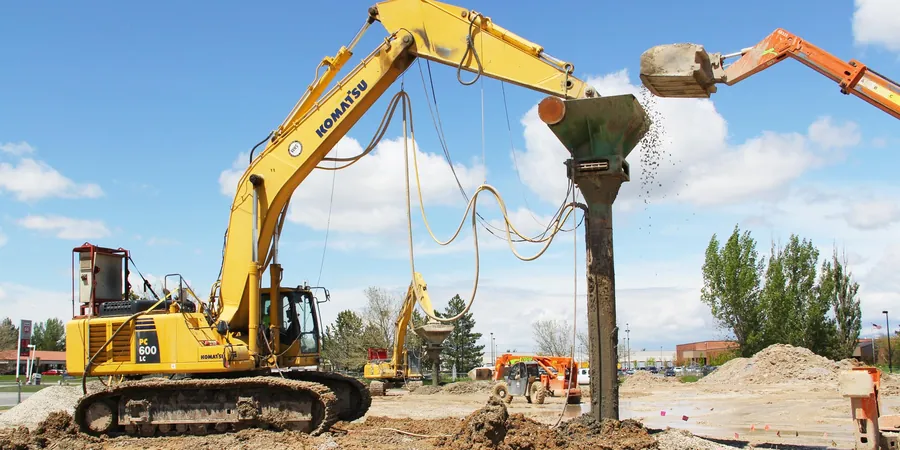
We target a post-densification relative density of at least 70% across the project footprint in Delta BC granular soils.
Methodology applied in Delta BC
Local geotechnical conditions in Delta BC
A common mistake we see in Delta BC is skipping the fines characterization before starting vibrocompaction design. When the silt content exceeds 15 to 20%, the vibration energy dissipates and densification drops off sharply. Contractors who proceed without a detailed sieve analysis and plasticity index end up with uneven compaction, settlement after construction, and liquefaction potential that remains unmitigated. Another error is ignoring the effect of lateral confinement near slopes or bulkheads. Without proper boundary assessment, the compaction pattern needs adjustment. We always run a trial area first to calibrate spacing, probe type, and backfill volume before scaling up to full production.
Our services
We deliver three core vibrocompaction design services tailored to Delta BC conditions. Each service includes field supervision, post-treatment verification, and a final report.
Full-Design Vibrocompaction Package
Complete design from site investigation through compaction pattern layout, specification of probe type, backfill selection, and QA/QC verification with CPT and SPT.
Trial Area Calibration
A small-scale trial on your Delta BC site to determine optimal spacing, vibration parameters, and backfill volume before full production. Includes before-and-after density testing.
Verification Testing & Reporting
Post-treatment CPT, SPT, and relative density calculation. We produce a signed-off report certifying that the design criteria have been met, suitable for geotechnical review.
Frequently asked questions
What is the typical cost range for vibrocompaction design in Delta BC?
For a standard industrial site in Delta BC, the design and verification package typically ranges between CA$1,750 and CA$6,700. The final cost depends on site size, depth of treatment, and number of verification points.
At what fines content does vibrocompaction become ineffective?
When the percentage of material passing the #200 sieve exceeds 15 to 20%, the vibration energy attenuates quickly and densification drops sharply. A pre-treatment sieve analysis is essential to confirm applicability.
How deep can vibrocompaction treat in Delta BC soils?
With standard equipment, treatment depths of 15 to 25 meters are achievable in the loose Fraser River sands. The actual depth depends on probe power, soil density, and groundwater conditions.
Do you need a trial area before full-scale production?
Yes, we always recommend a trial area on every Delta BC project. It calibrates grid spacing, vibration frequency, and backfill volume, reducing the risk of under-treatment in the main area.