Soil conditions in North Delta, near the Burns Bog area, differ sharply from those in Tsawwassen. The former sits on deep peat and organic clays, while the latter has firmer glacial till beneath a thin crust. This contrast matters because preloading with surcharge design must account for how each soil layer compresses over time. For a warehouse in Tilbury or a road embankment on Annacis Island, the surcharge height and duration change based on local consolidation parameters. We combine settlement analysis with field data to set realistic preloading schedules, avoiding delays. Where soft layers exceed ten meters, we often integrate vertical drains, and our approach aligns with the consolidation behavior of each stratum to prevent under-consolidation after construction.
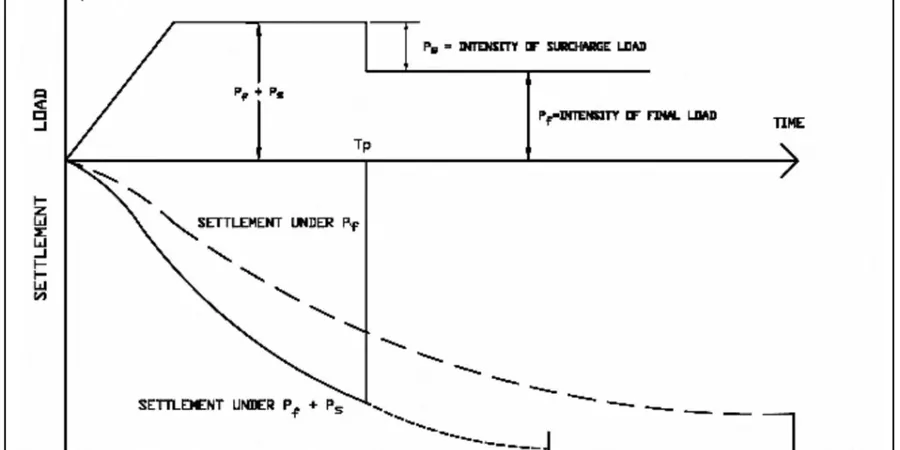
A surcharge ratio of 1.3 can cut primary consolidation time by 40% in Delta's soft clays, reducing project risk.
Methodology applied in Delta BC
Local geotechnical conditions in Delta BC
Delta BC sits on the Fraser River delta, where summer droughts alternate with winter rains that raise the water table by over a meter. This seasonal fluctuation re-saturates partially consolidated fills, potentially triggering rebound if the surcharge is removed too early. Preloading with surcharge design must factor in this wet-dry cycle, or the ground may swell unevenly. Additionally, the proximity to the Fraser River means that high tides can affect pore pressures in shallow layers, complicating the interpretation of settlement data. A solid monitoring plan with settlement plates and vibrating-wire piezometers is essential to avoid costly delays or rework.
Our services
We offer a full suite of services to support preloading with surcharge design in Delta BC, from initial site investigation to post-construction verification.
Settlement Analysis and Surcharge Design
We calculate primary and secondary consolidation using site-specific oedometer data, then size the surcharge load and duration to meet your settlement criteria.
Piezometer Installation and Monitoring
Vibrating-wire and standpipe piezometers track pore pressure dissipation in real time, allowing us to adjust the surcharge schedule if needed.
Settlement Plate and Survey Monitoring
Automated settlement plates with robotic total stations provide daily readings, so you know exactly when residual settlement falls within tolerance.
Geotechnical Instrumentation and Reporting
We deliver weekly reports with graphs of settlement vs. time, pore pressure trends, and updated predictions of when the surcharge can be removed.
Frequently asked questions
How long does preloading with surcharge typically take in Delta BC?
For most sites, primary consolidation finishes in 4 to 10 months, depending on clay thickness and surcharge height. We monitor settlement plates until the rate drops below 2 mm per week before recommending removal.
What is the typical cost range for a preloading with surcharge design?
The design and monitoring package for a typical project in Delta BC runs between CA$1.200 and CA$3.010, covering analysis, instrumentation, and reporting. Larger sites with multiple zones may cost more.
Do I need a preloading with surcharge design for a small warehouse slab?
Yes, if your site has more than 3 m of soft clay or peat. Without surcharge, residual settlements can exceed 100 mm, causing slab cracking and door misalignment. A design tailors the surcharge height to your specific soil profile.
Can I combine preloading with vertical drains?
Absolutely. In Delta BC, where clay layers exceed 8 m, we often pair surcharge with prefabricated vertical drains to accelerate drainage. This combination can cut consolidation time by half compared to surcharge alone.