We worked on a four-story commercial block near the Delta Nature Reserve where the peat layer reached nearly nine meters. The structural engineer needed bearing capacity that the native organic silt simply could not provide. That is exactly when deep soil mixing design becomes the practical solution. By blending cementitious binders in situ, we turn those weak strata into competent ground. The process creates soil-cement columns that work both in compression and as shear reinforcement. Before specifying the mixing pattern, we always run a classification of soils to map the organic content distribution accurately. That data drives the binder dosage and the column layout. For Delta BC, where the Fraser River delta deposits dominate, this upfront characterization is non-negotiable.
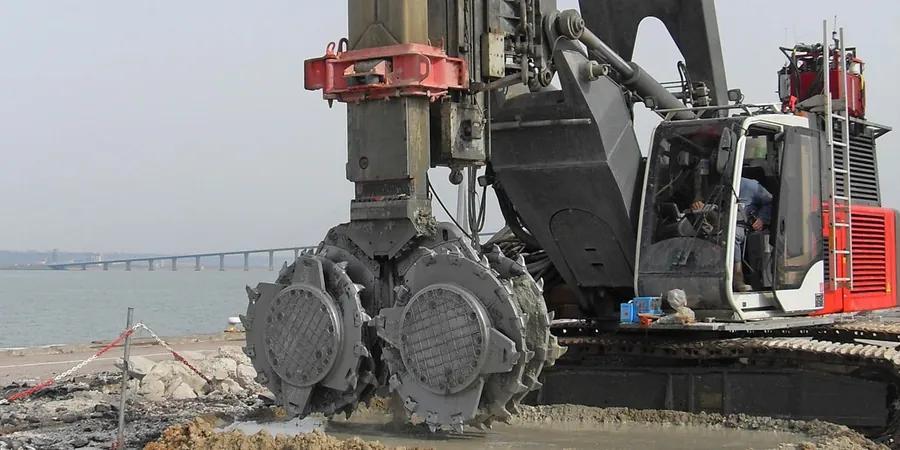
Deep soil mixing in Delta BC transforms compressible peat and soft clay into a load-bearing matrix that supports medium-rise structures without deep foundations.
Methodology applied in Delta BC
Local geotechnical conditions in Delta BC
The most common mistake we see in Delta BC is treating deep soil mixing as a generic ground improvement method without adjusting the mix design to local peat chemistry. Peat contains humic acids that retard cement hydration. If the binder composition does not account for that organic interference, the columns may never achieve the design strength. We have taken over projects where columns failed quality control because the contractor used a standard Portland cement blend. The result was soft columns that could not support the foundation loads. Another frequent error is ignoring the lateral variability of the delta deposits. Column spacing that works in one area may leave untreated pockets in another. That is why we always combine the mixing design with a tomografia sismica survey to map the subsurface continuity before finalizing the layout.
Our services
We offer three complementary deep soil mixing services tailored to the geotechnical conditions of Delta BC.
Laboratory Mix Design & Optimization
We prepare soil-cement specimens using site-specific peat and clay samples. The laboratory phase determines the optimal binder type, dosage, and water content to achieve the target strength and stiffness. Results include unconfined compression tests at 7, 14, and 28 days.
Field Trial Panel & QA/QC
Before production, we install a trial panel of at least five columns. We extract wet grab samples and core the hardened columns to verify diameter, continuity, and strength. The field program validates the design assumptions and adjusts the mixing parameters if needed.
Production Design & Structural Integration
We produce the final column layout, including area replacement ratio, depth, and spacing for each foundation element. The design integrates with the structural engineer's load take-down and includes settlement and stability calculations for the treated ground.
Frequently asked questions
How deep can deep soil mixing columns reach in Delta BC?
In Delta BC we typically design columns between 6 and 15 meters depth. The practical limit is governed by the torque capacity of the mixing tool and the presence of dense sand layers below the soft delta deposits. For deeper treatment we may consider alternative methods like jet grouting.
What binder is most effective for Delta BC peat?
A blend of Portland cement and ground granulated blast furnace slag at a 50:50 ratio works best. The slag reduces the retarding effect of humic acids in the peat. We always verify the binder performance through laboratory trial mixes before field application.
Does deep soil mixing work for seismic retrofit of existing foundations?
Yes, it is an effective solution for seismic retrofit. The columns increase the shear strength of the ground and reduce liquefaction potential in the loose sand layers underlying the peat. We design the column grid to create a reinforced soil block that behaves as a rigid foundation.
What is the typical cost range for deep soil mixing design in Delta BC?
The cost for deep soil mixing design and installation in Delta BC ranges between CA$2,340 and CA$9,420 per project depending on the treatment volume, column depth, and binder quantity. This includes laboratory mix design, field trials, and production oversight.