Delta BC grew rapidly in the mid‑20th century as farmland gave way to residential subdivisions and industrial parks. Much of the municipality sits on thick deposits of Fraser River Delta silt and clay, which are highly compressible and prone to long‑term settlement. For any new development on these low‑lying lands, prefabricated vertical drain design becomes essential to accelerate consolidation and achieve stable ground. Without proper drainage, post‑construction settlement can reach tens of centimeters. The city’s history of dyke construction and land reclamation shows that managing soft ground is a local engineering tradition, and modern PVDs are simply a refined version of that approach. When paired with a pre‑load program, vertical drains turn months of waiting into weeks of controlled settlement.
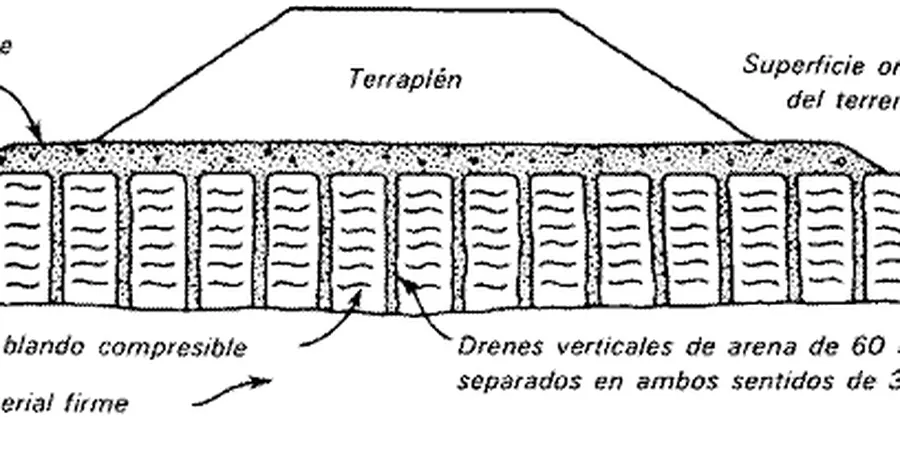
In Delta BC’s soft clays, proper PVD spacing and pre‑load timing can cut consolidation time by more than 80 % compared to natural drainage alone.
Methodology applied in Delta BC
- Spacing: typically 1.2 m to 2.0 m on a triangular grid
- Drain type: band drains 100 mm × 4 mm with a filter permeability > 1 × 10⁻⁴ m/s
- Installation depth: up to 30 m through silt and clay layers
Local geotechnical conditions in Delta BC
North Delta, near the escarpment, has firmer glacial till and less need for deep drainage. But in South Delta, around Boundary Bay and the Burns Bog area, the clay extends more than 40 m deep. The risk of differential settlement is highest where fill thickness varies across a site. A poorly designed PVD layout in these southern tracts can leave soft pockets that settle years after the building is finished. The biggest concern is shear failure of the foundation during pre‑loading — the clay can squeeze sideways if the load is applied too quickly. That is why staged construction and field instrumentation go hand‑in‑hand with the drain design.
Our services
We offer a complete prefabricated vertical drain design service for Delta BC, from site investigation to construction monitoring. Our team tailors every solution to the local clay stratigraphy and project schedule.
PVD Layout & Spacing Optimization
We calculate optimal drain spacing and depth using consolidation theory and local soil data. Our designs minimize installation cost while meeting settlement targets.
Pre‑Load & Surcharge Integration
We design the pre‑load program to work with the drain array, specifying fill height, staging, and waiting periods based on field monitoring feedback.
Field Instrumentation & Monitoring
We install settlement plates, piezometers, and inclinometers to track consolidation progress and adjust the design in real time if needed.
Frequently asked questions
What does a prefabricated vertical drain design cost in Delta BC?
A typical design package for a medium‑sized site (1–3 ha) ranges from CA$1,000 to CA$3,510, depending on the number of borings, drain layout complexity, and reporting requirements. The cost may vary if additional field testing or monitoring is needed.
How deep can vertical drains be installed in Delta BC clays?
In the Fraser River delta, drains can be installed to depths of 30 m or more, but the practical limit is often set by the presence of sand or gravel layers that cause excessive mandrel wear. For most residential and commercial projects in Delta BC, the target depth is between 12 m and 25 m.
How long does consolidation take with PVDs versus without?
With PVDs, 90 % consolidation can be achieved in 3 to 6 months for a typical 6 m clay layer. Without drains, the same layer would take 2 to 5 years. The exact time depends on drain spacing, soil properties, and the applied surcharge.