Delta BC grew rapidly from a farming community into a suburban hub after the 1960s, but its location on the Fraser River delta means much of the city sits on soft, alluvial soils that amplify seismic waves. These Holocene deposits, over 300 meters thick in places, create conditions where earthquake shaking is magnified significantly compared to bedrock sites. Any structure founded here, from a three-story condominium in Ladner to a warehouse in Tilbury, demands a thorough evaluation of how the ground will respond during a seismic event. The local geotechnical community has long recognized that standard building code provisions alone cannot capture the complex wave propagation through these deep sediments, which is why a dedicated site response analysis becomes essential for safe and economical design in Delta BC. Complementing this work with a microzonificación sísmica helps map amplification patterns across the municipality, while data from MASW-VS30 surveys provides the shear-wave velocity profiles needed for accurate modeling.
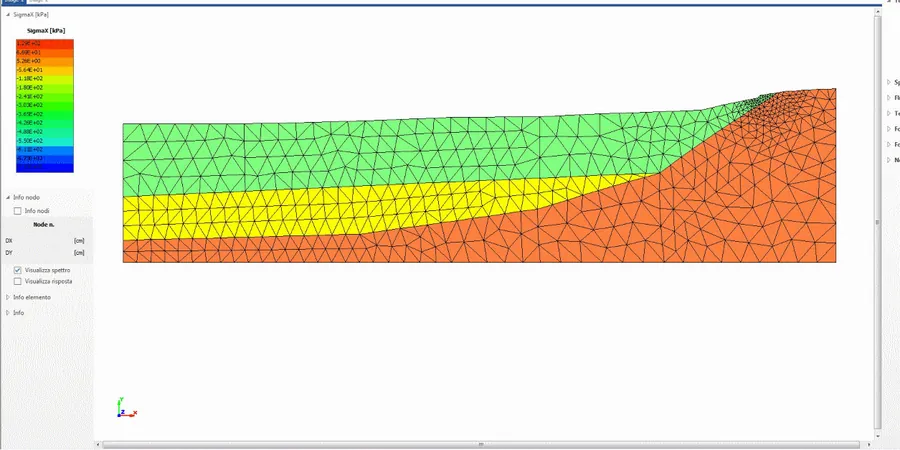
In Delta BC, deep soft sediments amplify long-period waves by 2–3x versus bedrock — site response analysis captures this.
Methodology applied in Delta BC
Local geotechnical conditions in Delta BC
The National Building Code of Canada (NBCC 2020) classifies Delta BC as Seismic Hazard Zone 4 with moderate-to-high ground motion probabilities, but the real risk lies in the soft soil amplification and potential liquefaction of the Fraser River sands. Without a site-specific analysis, designers default to the code's generic Site Class E amplification factors, which can underestimate spectral accelerations at longer periods by 40–60% for deep deposits. This mismatch directly affects structural design forces, particularly for mid-rise buildings and long-span structures. Furthermore, the thick clay layers can trap and elongate seismic waves, increasing the duration of shaking and raising the risk of cyclic softening in sensitive marine clays. A proper response analysis integrates shear-wave velocity profiles, modulus reduction curves, and site-specific hazard deaggregation to produce realistic design spectra, avoiding both unsafe under-design and costly over-design.
Our services
Our team provides a complete suite of site response analysis services in Delta BC, from field data acquisition to numerical modeling and reporting.
Shear-Wave Velocity Profiling (MASW/ReMi)
Non-invasive surface wave surveys to obtain VS30 and layered velocity models down to 100 m depth. Ideal for soft soil sites in Delta BC where drilling costs are high.
Equivalent-Linear & Nonlinear Ground Response Analysis
Using codes such as DEEPSOIL and FLAC to compute surface response spectra from input motions scaled to NBCC 2020 UHS. Includes strain-compatible modulus and damping.
Liquefaction Assessment & Cyclic Softening Evaluation
Combines SPT, CPT, and shear-wave velocity data with laboratory cyclic testing to evaluate triggering and post-liquefaction settlement for Delta BC's Fraser River sediments.
Frequently asked questions
What is the difference between a site response analysis and a standard geotechnical investigation?
A standard investigation provides soil properties and bearing capacity, while a site response analysis specifically evaluates how earthquake waves propagate through the soil column and amplify at the surface. In Delta BC, where soft sediments dominate, the analysis produces site-specific acceleration spectra that replace generic code spectra, directly affecting structural design forces and foundation requirements.
How much does a site response analysis cost in Delta BC?
The typical cost ranges from CA$1.810 to CA$6.530, depending on the number of boreholes, depth of profiling, laboratory testing (resonant column, cyclic triaxial), and complexity of the numerical analysis. A basic MASW survey with equivalent-linear analysis for a small residential project falls at the lower end; a multi-borehole nonlinear study for a mid-rise tower requires the full budget.
What input ground motions are used for Delta BC?
We use the NBCC 2020 Uniform Hazard Spectra (UHS) for the Delta BC location, deaggregated by magnitude and distance. Typically, we select 5–10 real or synthetic accelerograms matching the UHS for magnitudes M6.0–M7.5 at distances of 30–80 km. These are scaled to the target spectrum and applied as input at the engineering bedrock depth.
Do I need a site response analysis for a one-story house in Delta BC?
For most single-family homes on spread footings, the NBCC prescriptive seismic provisions suffice. However, if the house is on a very soft site (VS30 below 150 m/s) or near a known liquefaction hazard zone, a site response analysis may be recommended by the local building authority to verify that the foundation system remains stable under earthquake shaking. The analysis can also optimize slab reinforcement and grade beam design.