A contractor once called us after the first rain turned a freshly graded access road in Delta BC into a mud pit. The top 40 cm of silty clay had lost all bearing capacity overnight. That is the reality of building on the delta floodplain. Instead of removing and replacing the entire subgrade, we recommended a targeted soil stabilization for roads program using quicklime. Within 48 hours the moisture dropped from 32% to 18%, and the CBR went from 2 to 8. That road is still in service five years later. For deeper soft layers we often pair stabilization with deep soil mixing to treat zones below the active depth. The key is acting before the pavement goes down.
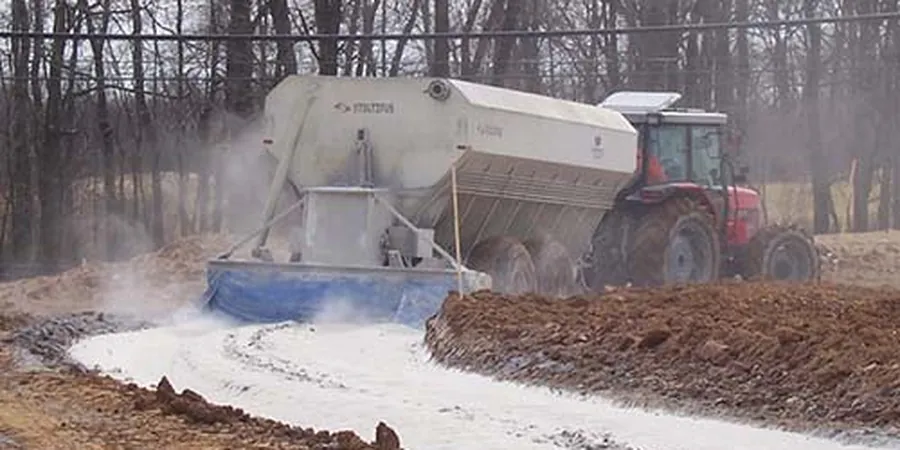
Delta BC subgrades need stabilization before pavement — untreated silt gains strength slowly and rutting appears within the first wet season.
Methodology applied in Delta BC
Local geotechnical conditions in Delta BC
We roll out a Wirtgen WR 240 recycler for the mixing passes — it cuts 50 cm deep and blends binder into the soil at a steady 4 km/h. The real risk in Delta BC is underestimating the variability of the Fraser silt: one test pit can show lean clay, while 20 m away the same depth is organic silt. If the binder dosage is uniform across a variable subgrade, some sections will remain soft and others become brittle. That is why we run a density cone test every 50 m along the road alignment to catch changes before the compaction roller arrives. A second pass with the stabilizer often solves the problem without wasting material.
Our services
We provide four integrated services for soil stabilization for roads in Delta BC, each tailored to the local soil conditions.
Subgrade Investigation and Sampling
Test pits and auger borings to profile the soil layers, classify the material (USCS), and determine natural moisture content and Atterberg limits.
Mix Design and Dosage Optimization
Lab-scale mixing of soil with cement, lime, or fly ash to find the minimum binder content that meets target strength and durability criteria.
Field Application and Quality Control
On-site mixing with a reclaimer-stabilizer, followed by compaction control, density tests, and 7-day cores for unconfined compressive strength verification.
Performance Monitoring and Testing
Post-treatment CBR testing, plate load tests, and periodic moisture checks to confirm long-term stability before pavement construction.
Frequently asked questions
When is soil stabilization for roads necessary in Delta BC?
Whenever the subgrade CBR is below 5 or the plasticity index exceeds 15. Delta BC silts and clays typically fall in that range, so stabilization is standard for subdivision roads, industrial access, and collector streets.
What is the typical cost range for soil stabilization for roads in Delta BC?
The cost usually falls between CA$1.230 and CA$3.970 per 1000 sq ft, depending on binder type, mixing depth, and the number of test sections required for quality control.
How long does the stabilization process take before paving?
Lime-treated soils need a 24-to-48-hour mellowing period. Cement-treated soils can be compacted immediately and paved after 7 to 14 days once the strength tests pass. Total time from mixing to paving is typically 10 to 21 days.
Does stabilization work on organic soils found in Delta BC?
High-organic layers (loss on ignition above 10%) do not respond well to lime or cement alone. For those zones we recommend mechanical removal or a combination of stabilization and geotextile reinforcement to bridge the soft material.