The contrast between the sandy levees of Ladner and the soft organic clays of Tilbury Island highlights why jet grouting design in Delta BC demands a site-specific approach. While the former may need only low-pressure permeation grouting to densify loose sands, the latter typically requires high-energy double- or triple-fluid jet grouting to create columns of cemented soil within compressible silts and peats. Our laboratory has executed parameters for over forty jet grouting design campaigns across the municipality, calibrating water-cement ratios and nozzle geometry against local grain size distributions. Before specifying a treatment pattern, we always cross-reference against deep soil mixing data to decide which technology yields the highest strength gain for the target depth interval. The Fraser River delta's layered stratigraphy makes this decision non-trivial: a single borehole can encounter peat, clay, and sand within five vertical metres.
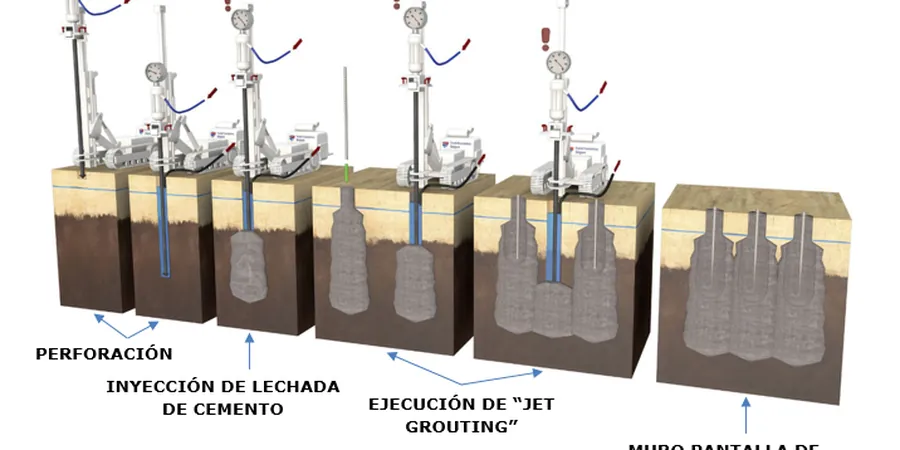
Jet grouting column diameters in Delta BC vary from 1.2 m in clay to 2.0 m in sand, requiring site-specific nozzle calibration for each target layer.
Methodology applied in Delta BC
- Water-cement ratio: 0.8:1 to 1.2:1 by weight, depending on silt content
- Grout withdrawal rate: 3–8 cm/sec, adjusted if column overlap is required
- Air pressure: 8–12 bar for triple-fluid systems in fine-grained soils
- Washout resistance: critical when treating below the water table in Delta BC
Demonstration video
Local geotechnical conditions in Delta BC
NBCC 2020 Division B, Part 4 sets the seismic design requirements for foundations, and in Delta BC the liquefaction susceptibility of the shallow sand layers demands that jet grouting design account for cyclic degradation. If the treated ground does not achieve a minimum shear wave velocity of 250 m/s, the structure may still require deep foundations. We combine jet grouting with liquefaction assessment to verify that the improved zone can resist the design earthquake loading. Local experience shows that a treatment radius of 1.5 m is often insufficient when the underlying peat layer exceeds 3 m thickness, so we always require verification coring at every fifth column.
Our services
We provide two complementary jet grouting design services tailored to Delta BC ground conditions. Each service includes field trials, parameter calibration, and post-treatment verification.
Jet Grouting Column Design for Soft Ground
For sites underlain by organic silts and peats common in Delta BC, we design double- and triple-fluid jet grouting systems. The service includes trial column execution, cored strength testing, and column layout optimization to achieve target bearing pressures of 200–400 kPa.
Jet Grouting for Seismic Mitigation
When liquefaction or lateral spreading is a concern, we design jet grouting panels and grids that increase the shear strength of loose sands. The service includes cyclic triaxial testing on treated samples and verification of settlement reduction under design earthquake loads.
Frequently asked questions
What is the typical cost range for jet grouting design in Delta BC?
For a standard project in Delta BC, the design and field trial phase ranges between CA$2,380 and CA$8,620. This includes parameter calibration, trial column execution, coring, and a design report. Larger projects with multiple treatment zones may fall at the upper end.
How does jet grouting design differ for Delta BC compared to other regions?
Delta BC's Fraser River delta soils are highly layered, with peat, soft clay, and loose sand within short depth intervals. Our design must account for variable washout resistance and column diameter loss in organic layers, which is less common in glacial till regions.
What verification testing is required after jet grouting treatment?
We require continuous coring of at least 10% of columns, with unconfined compression tests on recovered samples. Cross-hole tomography or seismic cone tests are used to confirm column continuity and shear wave velocity when seismic mitigation is the objective.
Can jet grouting be used to treat ground below the water table in Delta BC?
Yes, jet grouting is effective below the water table, but the water-cement ratio must be reduced to 0.8:1 to prevent washout. We also add bentonite (2–5% by weight) to improve cohesion in the wet granular soils typical of the Burns Bog area.
What is the minimum column overlap required for a continuous cutoff wall?
For a watertight cutoff wall, we design a minimum column overlap of 0.3 m at the design diameter. In Delta BC's soft clays, we increase this to 0.5 m to account for potential diameter reduction in organic layers.