A three-story townhouse complex on River Road was sinking into the peat. The builder had backfilled with clean sand, but within two years the slab had settled 12 cm. The problem was a 5 m layer of highly compressible organic silt beneath the fill, plus a seasonal water table that fluctuated 2 m. We designed a cement-bentonite grouting program that filled the large voids in the organics and stiffened the upper 3 m of soil before the new foundation. The job required a low-mobility grout with a Marsh cone viscosity of 35 seconds and a 28-day unconfined compressive strength of 1.5 MPa. Without that tailored grouting design, the building would have kept settling for another decade. The Fraser Delta's deep soft deposits make grouting design essential for any structure on fill or compressible layers.
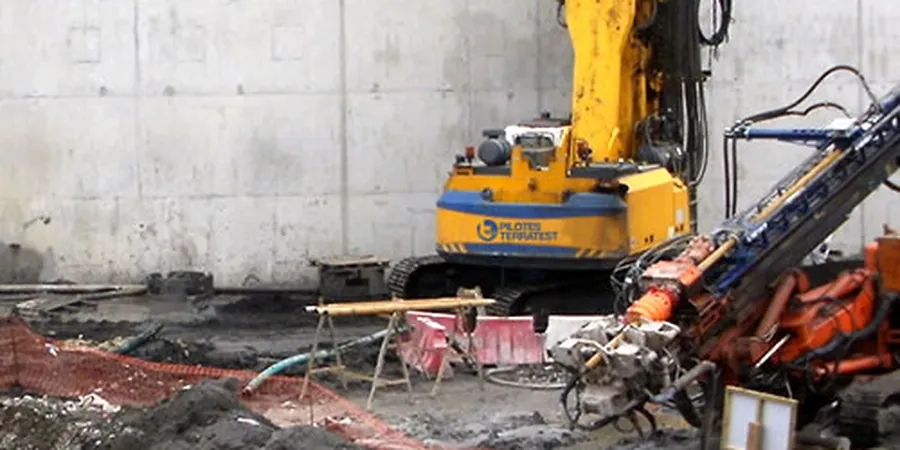
A low-mobility cement-bentonite grout with Marsh cone viscosity of 35 seconds and 1.5 MPa strength can stop differential settlement in Delta BC's organic silts.
Methodology applied in Delta BC
- Water/cement ratio: 0.45 to 0.60 by weight
- Bentonite content: 2 to 5% of dry weight for bleed control
- Silica fume: 8 to 12% when low permeability is needed
- Superplasticizer: 1 to 2 L per 100 kg of cement for flowability
Local geotechnical conditions in Delta BC
The most common mistake builders make in Delta BC is assuming that a single grout mix works everywhere. They order a standard cement grout from the batch plant and inject it into peat or silt without adjusting the water/cement ratio or adding bentonite. The result is grout that bleeds 15% water, leaving a weak skeleton that settles under the slab. In one case on Ladner Trunk Road, the contractor used a 0.70 w/c ratio for a void-fill job, and the grout column collapsed under the weight of a backhoe three weeks later. The repair cost three times the original grouting design. The delta's layered soils demand a mix that matches the void size and groundwater chemistry — a one-size-fits-all approach simply doesn't work here.
Our services
We provide two specialized grouting services that address the specific challenges of Delta BC's alluvial and organic soils: void filling for settlement control and permeation grouting for groundwater management.
Void Filling Grouting
Low-mobility cement-bentonite grout injected at 50 to 200 kPa to fill large voids in peat, organic silt, and loose sand. Typical injection rate is 0.5 to 2 m³ per hour per hole. Designed to reach 1.5 to 3.0 MPa compressive strength at 28 days, with a Marsh cone viscosity of 30 to 40 seconds for controlled placement.
Permeation Grouting
Fine-grained cement or chemical grout injected at 100 to 300 kPa to reduce permeability of silty sands and fine sands. Target void ratio of 0.4 to 0.6, with a final permeability of less than 10⁻⁶ m/s. Used for cutoff walls and groundwater control around deep excavations in Delta BC's deltaic deposits.
Frequently asked questions
What is the difference between void filling and permeation grouting?
Void filling targets large openings in peat, organic silt, or loose sand, using a low-mobility cement-bentonite mix that fills cavities and stiffens the soil. Permeation grouting targets the pore spaces in fine sands and silty sands, using a fine-grained cement or chemical grout to reduce permeability. Void filling is for settlement control; permeation grouting is for groundwater cutoff.
What is the typical cost range for grouting design in Delta BC?
A full grouting design including site investigation, mix design, and injection plan typically ranges from CA$1,890 to CA$6,050, depending on the number of injection points, depth, and required testing. This does not include drilling or grout materials, which are billed separately by volume.
How does the high water table in Delta BC affect grouting design?
The water table in Delta BC is typically 1 to 3 m below ground surface and can fluctuate 2 m seasonally. A high water table reduces the effective stress on the grout column and can cause bleed water to accumulate at the top of the injection zone. The grout mix must include bentonite for bleed control and silica fume for low permeability, and injection pressure must be limited to 150 kPa to avoid hydrofracturing the soil.
When should I use chemical grout instead of cement grout?
Chemical grout (typically acrylate or polyurethane) is used when the target soil has a grain size finer than 0.1 mm, or when the grout must penetrate very small voids without fracturing the soil. In Delta BC, chemical grout is common for cutoff walls in silty sand layers and for stabilizing loose sand during excavation. Cement grout is preferred for larger voids and higher strength requirements.