Delta BC sits on Fraser River delta deposits, where soft silts and peats underlie much of the road network. For any pavement rehabilitation project, we follow ASTM D4694-09 for falling weight deflectometer testing and ASTM D5361-16 for core sampling. The high water table here accelerates subgrade weakening, so a proper existing pavement evaluation is the first step before any overlay or reconstruction. We combine deflection data with layer thickness measurements to back-calculate structural capacity. Without this baseline, you risk premature cracking or rutting within two seasons. That is why our team prioritizes a thorough existing pavement evaluation in Delta BC before recommending any treatment.
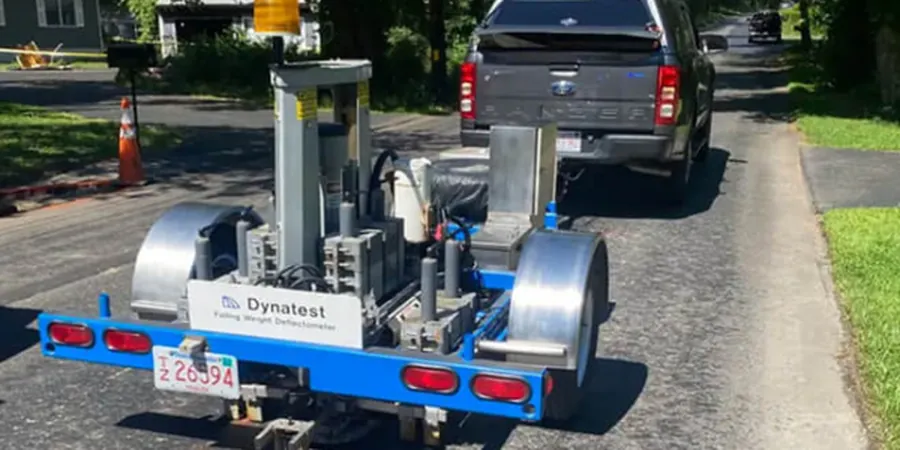
We back-calculate layer moduli from FWD deflection basins to quantify remaining structural life before recommending any treatment.
Methodology applied in Delta BC
- Falling weight deflectometer deflections (D1 to D7)
- Asphalt core thickness and density
- Subgrade California Bearing Ratio (in-situ)
- Layer moduli back-calculation via ELMOD or equivalent software
- Pavement condition index (PCI) per ASTM D6433
Local geotechnical conditions in Delta BC
Our FWD trailer and core rig operate on Delta BC roads under live traffic control. The main risk during fieldwork is encountering shallow utilities or irrigation lines buried at less than 0.5 m depth. We coordinate with the municipality and use a utility locator before every core cut. If the asphalt layer is less than 40 mm thick, the core barrel can shatter the sample, so we adjust the drilling speed and use a diamond-impregnated bit. High groundwater can also flood the test pit if we need to expose the subgrade. We mitigate this by scheduling during the dry summer months and using a dewatering pump on standby.
Our services
We offer two complementary services tailored to Delta BC's geotechnical conditions.
FWD Deflection Testing and Back-Calculation
A 20-tonne FWD applies a 40-kN impulse load and measures surface deflections with seven seismometers. We run the test at 20-metre intervals and use ELMOD to back-calculate layer moduli. Results are delivered as a deflection profile and remaining life estimate.
Asphalt Core Sampling and Laboratory Testing
We extract 100-mm diameter cores using a trailer-mounted drill rig with diamond bits. Each core is measured for thickness, density, and visually inspected for stripping, raveling, or oxidation. Selected cores undergo Marshall stability and flow testing per ASTM D6927.
Frequently asked questions
How long does an existing pavement evaluation take in Delta BC?
A typical evaluation covering 1 km of road takes two days of fieldwork plus one week for laboratory testing and reporting. The schedule depends on traffic control permits and the number of core samples requested.
What is the difference between FWD testing and coring?
FWD testing measures the structural response of the entire pavement system under a simulated load. Coring gives you physical thickness and material condition of the asphalt layer. Both methods are complementary for a complete existing pavement evaluation.
How much does an existing pavement evaluation cost in Delta BC?
The cost ranges between CA$1,470 and CA$4,530 depending on the number of FWD test points, core samples, and laboratory tests required. Contact us for a quote tailored to your project length and scope.
Do you need traffic control for the FWD testing?
Yes, we coordinate with the municipality and a certified traffic control company. The FWD truck occupies one lane for about two minutes per test point. We typically schedule testing during off-peak hours to minimize disruption.