Too many contractors in Delta BC skip a proper slope stability analysis before cutting or filling on sloped lots. The Fraser River delta front and Burns Bog margins present layered silts and peat that fail without warning when saturated. We use limit equilibrium and finite element methods to calculate factor of safety under worst-case groundwater conditions. Before any slope work, we recommend pairing this analysis with a MASW survey to map stiffness contrasts across the site. That combination catches weak zones that standard borings might miss. Our team has evaluated dozens of slopes in Delta BC, from highway embankments along Highway 17 to residential developments near the Boundary Bay shoreline.
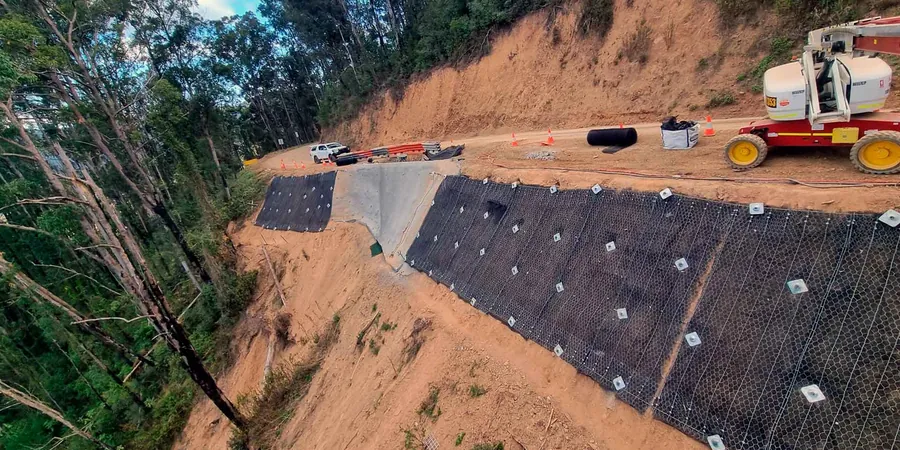
Peat lenses can drop the factor of safety by 0.3 or more if not modeled correctly in Delta BC's layered deltaic soils.
Methodology applied in Delta BC
Local geotechnical conditions in Delta BC
In Delta BC, we often see slopes that looked stable during dry summer months fail the following spring when groundwater rises. The risk is highest along the Fraser River south arm and near drainage ditches where seepage exits at the toe. A single heavy rainfall event can raise pore pressures enough to trigger a translational slide in layered silts. We quantify this using steady-state and transient seepage modeling tied to local precipitation records. Ignoring this seasonal shift is the most common cause of slope failures in Delta BC residential subdivisions. Our reports include groundwater monitoring recommendations so you catch the problem before it moves.
Our services
We offer two tailored slope stability services for Delta BC projects.
Limit Equilibrium Analysis
Bishop simplified and Spencer methods using soil parameters from site-specific laboratory tests. We model multiple failure surfaces and compute factor of safety for static, pseudo-static, and rapid drawdown conditions. Output includes cross-sections with critical slip surface location.
Finite Element Seepage-Deformation Coupled Analysis
PLAXIS 2D models that simulate pore pressure evolution during rainfall or snowmelt events. Suitable for embankments, cut slopes, and retaining structures in Delta BC's soft soil environment. Results include deformation contours and safety maps for staged construction.
Frequently asked questions
What factor of safety is required for slope stability in Delta BC?
For static conditions, we target a minimum factor of safety of 1.5 for permanent slopes and 1.3 for temporary excavations. Under seismic loading per NBCC 2020, pseudo-static analysis requires a factor of safety of at least 1.1. These values follow FHWA-NHI-05 guidelines.
How does the peat layer in Burns Bog affect slope stability?
Peat has very low shear strength and high compressibility. When saturated, its undrained strength can drop below 15 kPa. Our analysis models peat as a separate stratum with distinct strength parameters, often reducing the overall factor of safety by 0.3 to 0.5 compared to models that ignore it.
What is the typical cost range for a slope stability analysis in Delta BC?
A standard limit equilibrium analysis with one borehole and lab testing ranges between CA$1.920 and CA$3.500. For a coupled finite element analysis including seepage modeling, the range is CA$3.800 to CA$6.230. Final cost depends on slope geometry, number of soil layers, and whether groundwater monitoring is required.
Do you include recommendations for remediation if the slope fails?
Yes. If the factor of safety is below target, our report recommends specific measures: drainage trenches to lower the water table, soil nailing, or buttress fills at the toe. We also include construction sequencing steps to avoid temporary instability during remediation.