The difference between clay soils in Tsawwassen and those near the Burns Bog area is significant. In Tsawwassen, the upper clay crust is stiff enough to support light loads, but just a few kilometers north the same layer turns soft and sensitive. Running an unconfined compression test on undisturbed samples from each zone reveals this contrast clearly. That is why we insist on site-specific UCS testing before any foundation design in Delta BC. The numbers from this simple test directly feed into bearing capacity calculations and settlement estimates. Without them, you risk overestimating strength in the soft pockets.
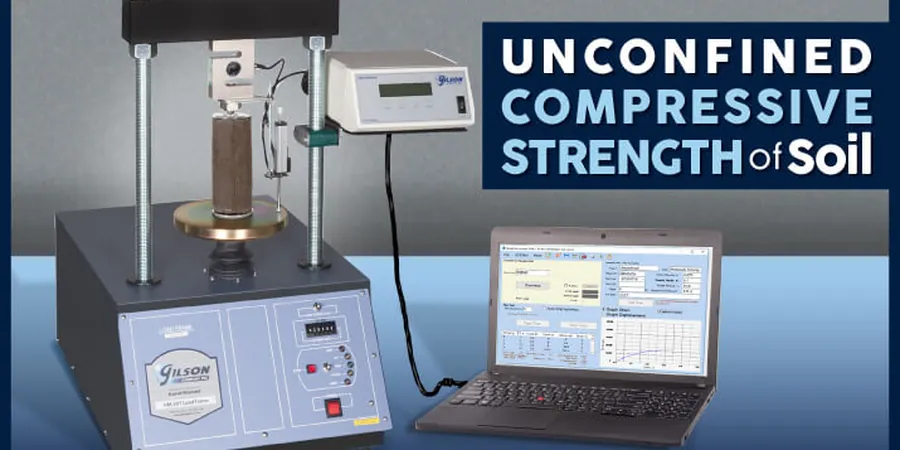
A single UCS value from Delta BC clay can change your foundation design from spread footings to piles. Test first.
Methodology applied in Delta BC
Local geotechnical conditions in Delta BC
A common mistake we see in Delta BC projects is skipping the unconfined compression test and assuming all clay layers are uniform. Builders often rely on pocket penetrometer readings alone, which only measure the surface crust. That leads to foundations designed for the stiff top layer while ignoring the soft clay beneath. The result is differential settlement, cracked slabs, and costly repairs. We have seen it happen in residential subdivisions near Ladner and industrial lots along River Road. A proper UCS program on samples from multiple depths catches those weak zones before concrete is poured.
Our services
We provide two complementary services that build on UCS results for complete geotechnical characterization in Delta BC.
Triaxial Compression Testing (UU and CU)
For projects requiring more detailed strength parameters, we run unconsolidated-undrained and consolidated-undrained triaxial tests. These provide cohesion and friction angle values needed for slope stability and deep foundation design.
Consolidation Testing (Oedometer)
When settlement prediction is critical, we perform one-dimensional consolidation tests on the same clay samples. This gives the pre-consolidation pressure and compression index for accurate deformation analysis.
Frequently asked questions
How long does an unconfined compression test take in your lab?
A standard UCS test on Delta BC clay takes about 3 to 5 working days from sample receipt. The time includes sample trimming, moisture content determination, loading, and report preparation. We can prioritize urgent samples if needed.
What is the cost of an unconfined compression test in Delta BC?
The typical price for a single UCS test at our lab ranges from CA$500 to CA$630. This includes sample preparation, the test itself, and a certified report. Volume discounts apply for projects with 10 or more samples.
Can UCS results be used for seismic design in Delta BC?
Yes, but only as part of a broader assessment. The undrained shear strength from UCS tests helps evaluate soil liquefaction triggering and post-cyclic strength loss. For seismic site response, we combine UCS data with shear wave velocity measurements and cyclic triaxial tests.