A common mistake local construction firms make in Delta BC is assuming uniform soil strength across the floodplain. The Fraser River delta deposits vary drastically in composition—sandy silt layers over soft clay—so relying on a single index property can lead to overestimated bearing capacities or unexpected settlement. We perform triaxial tests on undisturbed samples to define the actual Mohr-Coulomb envelope under drained and undrained conditions. This gives engineers the cohesion and friction angle needed for foundation design, slope stability checks, and earth retention calculations. Before moving to final design, we often pair this data with a tomografía sísmica to map subsurface variability across the site, ensuring the triaxial results represent the most critical strata.
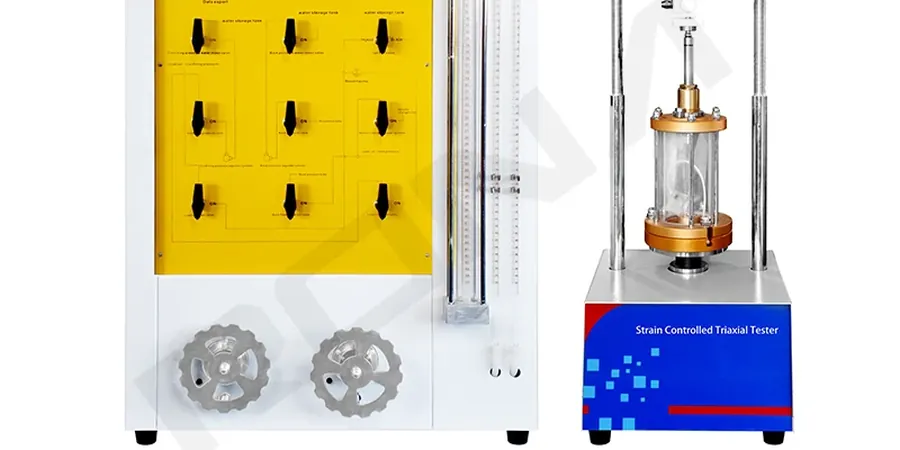
Triaxial tests on Fraser Delta soft clays often yield friction angles between 22° and 28° with cohesion intercepts below 5 kPa in the upper 10 meters.
Methodology applied in Delta BC
Typical parameters we report include:
Local geotechnical conditions in Delta BC
Delta BC has a population exceeding 100,000, and parts of the municipality sit at elevations below 2 meters above sea level—right on the Fraser River floodplain. During the 1946 Vancouver Island earthquake (M7.3), the soft deltaic soils here amplified ground motion significantly. Without triaxial test data, engineers cannot reliably assess undrained shear strength loss under cyclic loading, which directly affects liquefaction triggering evaluations and seismic foundation design. We integrate triaxial results with licuefaccion screening to identify zones where strength degradation could cause bearing failure or lateral spreading during a design-level earthquake.
Our services
We provide triaxial testing as part of our broader geotechnical laboratory services, with capabilities for both standard and advanced stress paths.
Consolidated-Undrained (CU) Triaxial with Pore Pressure
CU tests with back-pressure saturation and pore pressure measurement during shear. Ideal for assessing short-term stability in soft clays and silts common to the Fraser delta.
Consolidated-Drained (CD) Triaxial for Long-Term Loading
CD tests at slow strain rates to capture drained strength parameters for embankments, retaining walls, and slope stability analyses where pore pressures dissipate over time.
Frequently asked questions
What is the difference between UU, CU, and CD triaxial tests?
UU (unconsolidated-undrained) tests measure immediate shear strength without allowing drainage or consolidation; CU (consolidated-undrained) allows full consolidation before shearing with pore pressure measurement; CD (consolidated-drained) permits full drainage during shear, yielding long-term strength parameters. For Delta BC soft clays, CU tests are most common for short-term stability, while CD tests suit long-term embankment design.
How much does a triaxial test cost in Delta BC?
The typical cost for a triaxial test in Delta BC ranges from CA$2,260 to CA$3,320 per set of three specimens at different confining pressures, depending on test type (UU, CU, or CD) and whether pore pressure measurements are required. Volume discounts apply for multi-sample projects.
Which ASTM standard governs triaxial testing for this region?
The primary standards are CSA + CSA + CSA + CSA + ASTM D2850 (also CFEM Ch 2) (also CFEM Ch 2) (also CFEM Ch 2) (also CFEM Ch 2) (also CFEM Ch 2) for UU triaxial, ASTM D4767 for CU with pore pressure, and ASTM D7181 for CD tests. All three are referenced by the NBCC and local engineering practice in British Columbia.