Delta BC grew rapidly after the construction of the George Massey Tunnel and Highway 99 corridor, transforming former marshland and Fraser River floodplain into suburban communities. The underlying geology—thick deposits of Fraser River silt and clay—demands tight control over fill placement. A Proctor test in Delta BC establishes the optimum moisture content and maximum dry density for any engineered fill, whether for residential subdivisions on Ladner Trunk Road or industrial pads near Tilbury Island. This data directly informs compaction specifications and prevents long-term settlement issues. To complete the picture of subsurface conditions, we combine the Proctor test with a granulometry analysis for fines characterization and a field density test after compaction to verify achieved density.
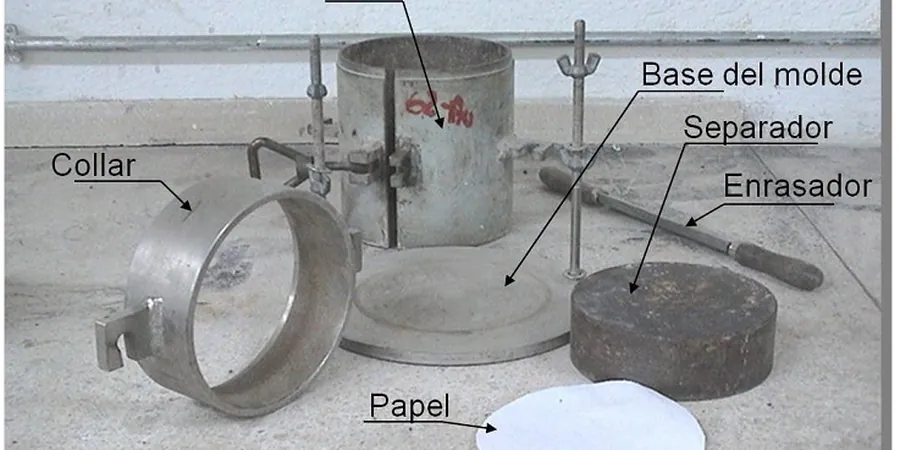
A Proctor test is the single most reliable method to establish compaction targets for engineered fill in Delta’s soft Fraser River sediments.
Methodology applied in Delta BC
Demonstration video
Local geotechnical conditions in Delta BC
I recall a warehouse development on River Road that skipped the Modified Proctor test for a high-load storage area. The contractor used a Standard Proctor target, compacted the silt fill at 18% moisture, and after six months the slab settled nearly 40 mm under rack loads. The repair required mudjacking and partial slab replacement. In Delta BC, where the natural water table sits just 2–3 m below grade, the consequence of inadequate compaction control is differential settlement that cracks floors, misaligns overhead doors, and strains foundations. A Proctor test in Delta BC is not a paper exercise—it directly prevents costly post-construction repairs.
Our services
We offer three tiers of Proctor testing tailored to different project scales and soil types in Delta BC.
Standard Proctor Test (ASTM D698 (also CFEM Ch 2) (also CFEM Ch 2) (also CFEM Ch 2) (also CFEM Ch 2) (also CFEM Ch 2))
Five-point compaction curve for soils with less than 30% retained on No. 4 sieve. Ideal for residential subdivisions, light commercial slabs, and general site grading in Delta BC. Includes moisture-density relationship and optimum moisture content determination.
Modified Proctor Test (ASTM D1557 (also CFEM Ch 2) (also CFEM Ch 2) (also CFEM Ch 2) (also CFEM Ch 2) (also CFEM Ch 2))
Higher compaction energy for structural fills, heavy-load industrial floors, and roadway subgrades. Used on Delta BC projects such as Tilbury distribution centers and Highway 17 embankments. Delivers higher target densities for increased load-bearing capacity.
Proctor with Field Verification Package
Combines lab Proctor test with on-site nuclear gauge or sand cone density tests. Our team brings the compactor to achieve the target density, then verifies it against the Proctor curve. Recommended for critical fills where settlement tolerance is under 15 mm.
Frequently asked questions
What is a Proctor test and why do I need one in Delta BC?
A Proctor test determines the optimum moisture content and maximum dry density for a soil. In Delta BC, where the natural Fraser River silt is moisture-sensitive, the test ensures your fill is compacted to the right density and water content to prevent settlement. It is required by most municipal building permits in the region.
How much does a Proctor test cost in Delta BC?
The price range for a Standard or Modified Proctor test in Delta BC is typically between CA$130 and CA$330 per test, depending on whether you need single-point or full five-point curve plus moisture content verification. Volume discounts apply for multi-location subdivisions or phased projects.
What is the difference between Standard and Modified Proctor?
The key difference is compaction energy. Standard Proctor (ASTM D698 (also CFEM Ch 2) (also CFEM Ch 2) (also CFEM Ch 2) (also CFEM Ch 2) (also CFEM Ch 2)) uses 12,400 ft-lb/ft³ and is suitable for light loads like sidewalks and residential slabs. Modified Proctor (ASTM D1557 (also CFEM Ch 2) (also CFEM Ch 2) (also CFEM Ch 2) (also CFEM Ch 2) (also CFEM Ch 2)) uses 56,000 ft-lb/ft³—about 4.5 times higher—and is specified for heavy-load areas like industrial floors, airport pavements, and highway subgrades.
How long does the Proctor test take and when will I get results?
A full five-point Proctor curve requires about 24 to 48 hours from sample receipt, including oven drying. We can provide preliminary single-point results within the same day for urgent projects, but the complete curve is necessary for reliable compaction specifications. Results are delivered electronically with a signed laboratory report.