A portable SPT rig sets up near the Fraser River in Delta BC. The crew assembles the tripod and hammer system over the silt and sand layers that dominate this region. Soil liquefaction analysis in Delta BC requires site-specific data collection. We drill and perform standard penetration tests every 1.5 meters. Samples go directly into sealed tubes. The team labels each tube with depth and borehole ID. Back at the lab, we run grain size curves and calculate cyclic resistance ratios. This data feeds into the simplified NCEER method. The goal is clear: determine whether loose saturated sands can trigger liquefaction during a design earthquake. For municipal infrastructure projects, we often combine this with a microzonificación sísmica study to map hazard zones across a whole district.
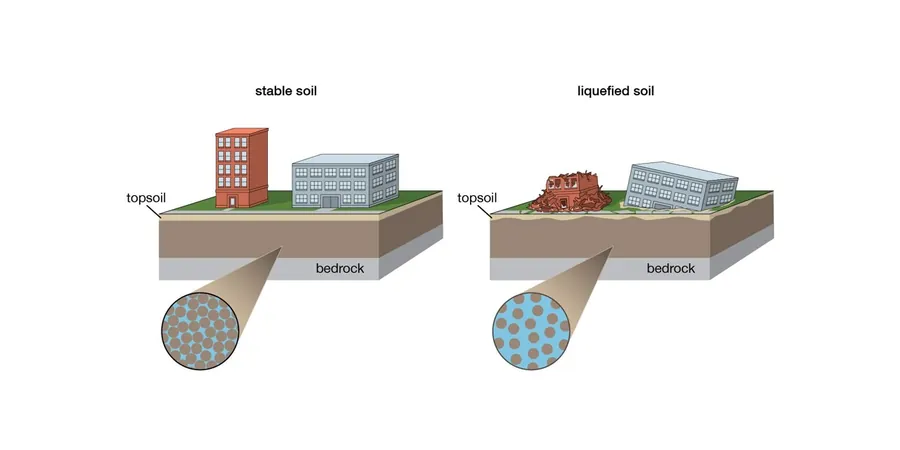
Loose Fraser Delta sands with high pore pressure pose real liquefaction risk. NCEER-based analysis with site-specific CPT data reduces uncertainty.
Methodology applied in Delta BC
Local geotechnical conditions in Delta BC
NBCC 2020 classifies Delta BC as high seismic hazard with a 2% in 50-year PGA exceeding 0.3g. That means a magnitude 6.5 to 7 earthquake near the Georgia Strait can trigger widespread liquefaction. The Fraser delta front and Burns Bog areas show the highest susceptibility. Loose sand units below the water table lose shear strength within seconds of shaking. Buildings tilt, pipelines rupture, and bridge abutments displace laterally. Ignoring this risk leads to differential settlements of 200 mm or more. That is why every new development in Delta BC requires a site-specific soil liquefaction analysis. We follow the NBCC 2020 site classification procedure and the NCEER workshop guidelines to produce defensible factors of safety.
Our services
We offer three specialized services for soil liquefaction analysis in Delta BC, each tailored to project scale and budget.
SPT-Based Liquefaction Assessment
Standard penetration testing with automatic hammers and energy calibration. N-values corrected for overburden, fines content, and rod length. CRR computed per Idriss-Boulanger 2008. Final report includes FS profiles and settlement estimates.
CPT-Based Liquefaction Evaluation
Cone penetration testing with pore pressure dissipation. Continuous qc, fs, and u2 readings at 2 cm intervals. Correlated to SPT-based CRR curves. Ideal for large sites where spatial variability matters.
Seismic Site Response & Lateral Spread
Shear wave velocity profiling using MASW or downhole methods. One-dimensional site response analysis in DeepSoil or equivalent. Calculates lateral displacement under seismic loading using Newmark sliding block method.
Frequently asked questions
What is the difference between CRR and CSR in liquefaction analysis?
CSR is the cyclic stress ratio imposed by the earthquake on a soil layer. CRR is the cyclic resistance ratio the soil can withstand before liquefying. If CSR exceeds CRR at a given depth, the factor of safety falls below 1.0.
How much does a soil liquefaction analysis in Delta BC cost?
Typical costs range between CA$3,110 and CA$5,370 for a standard project. This covers field SPT, lab testing, and a detailed report. Larger sites with CPT or MASW profiling may fall toward the upper end.
Which soil types in Delta BC are most prone to liquefaction?
Loose to medium dense silty sands and fine sands below the water table. These soils dominate the Fraser River delta deposits. Peat and organic clays are not liquefiable but can amplify shaking.
Do I need a liquefaction study for a single-family home in Delta BC?
It depends on the building footprint and foundation type. NBCC 2020 requires a geotechnical investigation for new construction in high seismic zones. Most municipalities in Delta BC enforce this for any new building permit.