In Delta BC, the difference between a site near the Fraser River and one on the upland area around the Burns Bog can be night and day when it comes to seismic response. The soft deltaic sediments amplify ground motion far more than the stiffer glacial till deposits found a few kilometers east. Our team has mapped these contrasts across dozens of projects, and we consistently see the need for site-specific seismic amplification analysis rather than relying on generic NBCC soil classes. For instance, when the subsurface includes thick layers of organic silt, a standard Class E assumption can underestimate peak ground acceleration by 20% or more. That is why we combine field geophysics with laboratory testing to calibrate the local response, often complementing the work with a MASW-VS30 survey to capture shear-wave velocity profiles and a seismic tomography for deeper structure.
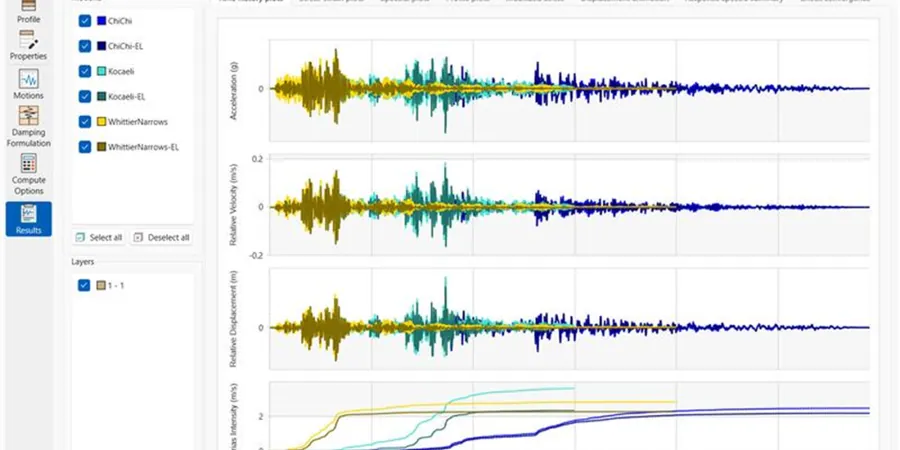
Soft deltaic sediments in Delta BC can amplify peak ground acceleration by over 20% compared to a bedrock site — site-specific analysis is non-negotiable.
Methodology applied in Delta BC
- Dynamic soil property testing (shear modulus reduction, damping curves) on undisturbed samples.
- One-dimensional and two-dimensional site response modeling using equivalent-linear and nonlinear codes.
- Validation against recorded ground motions from regional seismic arrays.
Demonstration video
Local geotechnical conditions in Delta BC
Delta BC grew quickly over the past five decades, with residential and industrial development spreading onto the delta's floodplain. Many of those areas were built before the current seismic codes recognized how much soft soils can magnify shaking. The 1946 Vancouver Island earthquake and the 2001 Nisqually event both produced stronger-than-expected motions in the Fraser delta. Without a proper seismic amplification analysis, a building designed to code minimums could experience accelerations 40% higher than assumed. That gap matters for everything from foundation design to nonstructural component anchorage. We have seen retrofit projects where the original design missed the amplification entirely, forcing expensive corrections later.
Our services
Our seismic amplification analysis in Delta BC is tailored to the local geology and project type. We offer two primary service lines:
Site-Specific Response Analysis
Full dynamic site response modeling including field geophysics (MASW, HVSR), laboratory cyclic testing, and 1D/2D numerical simulation. Delivered with spectral acceleration curves and design spectra per NBCC.
Seismic Microzonation for Large Sites
For subdivisions or multi-building developments, we produce amplification factor maps and zoning recommendations. Combines borehole data, VS30 profiling, and probabilistic hazard assessment.
Frequently asked questions
Why is seismic amplification a concern in Delta BC?
The delta's thick deposits of soft silt, clay, and peat can amplify earthquake ground motions by 1.5 to 2 times compared to bedrock. This increases spectral accelerations at periods that affect mid-rise buildings, making site-specific analysis essential for safe design.
What methods do you use for the analysis?
We typically combine MASW or ReMi surveys to measure shear-wave velocity profiles, downhole seismic testing for deeper layers, and resonant column or cyclic triaxial tests to define modulus reduction and damping curves. These inputs feed equivalent-linear or nonlinear site response software.
How much does a seismic amplification analysis cost in Delta BC?
The typical cost ranges between CA$1,420 and CA$3,030 depending on the number of boreholes, geophysical lines, and complexity of the numerical modeling. A preliminary desktop study for a single building is at the lower end, while a full microzonation for a large site reaches the upper range.