Delta BC grew on the Fraser River delta, where centuries of alluvial deposits created deep layers of soft clays and silts. As the municipality expanded its road network to connect Tilbury Island, Ladner, and Tsawwassen, engineers faced a recurring challenge: building stable embankments on ground that compresses under load. Our team has been designing road embankments in Delta BC since the early 2000s, adapting to the region's unusual geotechnical profile. Before any fill placement, we run a site investigation that typically includes cone penetration tests and soil sampling. For projects crossing the Burns Bog peat zones, we often pair the embankment analysis with a drainage geotechnical assessment to manage pore pressure dissipation during construction.
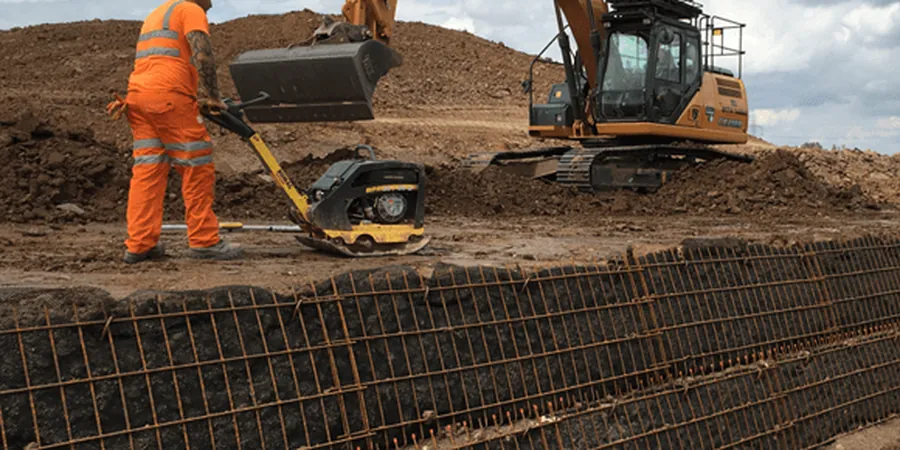
In Delta BC, the water table rarely drops below 1.5 m depth; embankment design must treat drainage as a primary load, not an afterthought.
Methodology applied in Delta BC
- Preconsolidation pressure (sigma_p) from oedometer tests
- Undrained shear strength from field vane or triaxial UU
- Compression index Cc for long-term settlement
- Pore pressure ratio ru for rapid drawdown scenarios
Local geotechnical conditions in Delta BC
Delta BC recorded a magnitude 6.8 earthquake in 1946, and the Fraser delta is classified under NBCC 2020 as seismic site class E for most areas. That means the road embankment design must handle not just static settlement but also cyclic softening and lateral spreading. The risk is real: a poorly designed embankment on these soft silts can lose several centimeters of crest height during a moderate event. We incorporate post-seismic settlement calculations and reinforce the fill with geotextiles or lightweight aggregates where needed. For critical routes like Highway 17 or the Deltaport connector, we run liquefaction triggering analyses using the Youd-Idriss method to confirm stability under the design earthquake.
Our services
We offer a full suite of services for road embankment design in Delta BC, from initial exploration to construction monitoring.
Embankment Stability Analysis
Limit equilibrium and finite element analyses for staged fill placement on soft ground. We model undrained and drained conditions using Bishop and Spencer methods.
Settlement and Consolidation Assessment
One-dimensional consolidation testing and numerical modeling to predict time-rate and magnitude of settlement. We include surcharge and PVD design as needed.
Seismic Ground Response
Site-specific response analysis using equivalent-linear or nonlinear methods. We evaluate cyclic strength reduction and permanent deformation under design earthquakes.
Geotechnical Instrumentation
Installation and monitoring of piezometers, inclinometers, and settlement plates during and after construction. Data feeds back into the design for observational method adjustments.
Frequently asked questions
How deep are the soft soils in Delta BC for embankment design?
Soft silts and clays extend from 10 to 30 meters depth across most of Delta BC, with occasional peat lenses up to 5 meters thick near Burns Bog. The depth affects both settlement magnitude and drainage design.
What is the typical cost for a road embankment design study in Delta BC?
The cost ranges from CA$1,690 to CA$4,930 depending on the embankment height, number of borings, and laboratory testing scope. Complex projects with seismic analysis or instrumentation fall at the upper end.
Which seismic site class applies to Delta BC embankments?
Most of Delta BC falls under NBCC site class E (very soft soil) due to the deep alluvial deposits and high water table. Site-specific vs30/" data-interlink="1">shear wave velocity measurements are recommended to confirm the classification.
How long does the consolidation phase take for a typical embankment?
Without vertical drains, primary consolidation can take 12 to 24 months for a 4-meter fill. With prefabricated vertical drains spaced at 1.5 meters, that time drops to 3 to 6 months, depending on the clay layer thickness.