A common mistake we see among contractors new to Delta BC is assuming a standard concrete slab thickness will hold up in the Fraser River delta's soft soils. The deep silts and peats beneath this region can cause differential settlement that cracks a rigid pavement within the first freeze-thaw cycle if the subgrade isn't properly characterized. Our team starts with a thorough subsurface investigation, including cone penetration testing to map soil variability, before we even begin the rigid pavement design. Without that step, even the best concrete mix design won't prevent early failure.
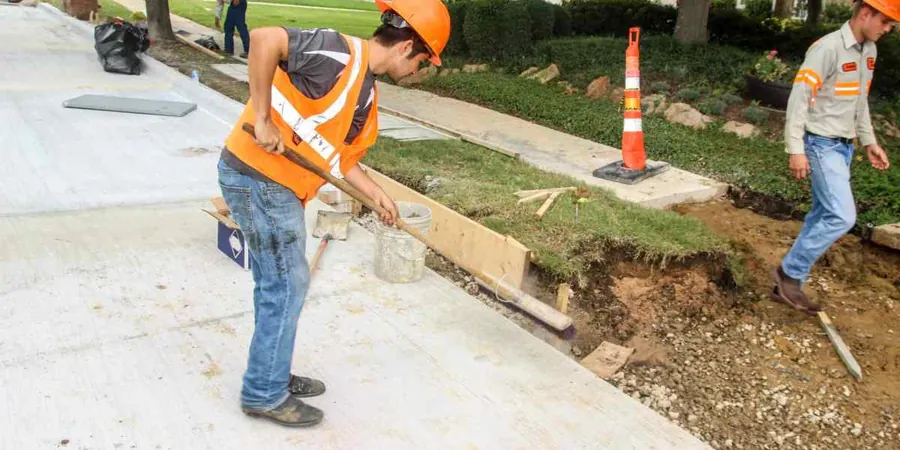
Delta BC's shallow water table and soft silts make rigid pavement design a site-specific challenge that demands careful subgrade testing before any mix or thickness is chosen.
Methodology applied in Delta BC
Local geotechnical conditions in Delta BC
The Fraser River delta's Holocene-age silts are normally consolidated, meaning they have never carried a load heavier than their own weight. When we place a rigid pavement on top, the subgrade undergoes primary consolidation that can exceed 50 mm of settlement over two to three years. If the rigid pavement design ignores this time-dependent settlement, the slab will lose support and develop corner cracks or faulting at joints. We have seen projects in Delta BC where a 250 mm slab cracked within the first year because the design assumed an instantaneous modulus rather than the long-term drained response of the silt.
Our services
Our rigid pavement design service covers the full scope from field investigation to final thickness calculations. We adapt each step to Delta BC's specific soil conditions.
Subgrade Characterization & Testing
We perform plate load tests, dynamic cone penetrometer surveys, and moisture-density analysis to establish the in-situ k-value and frost susceptibility of Delta BC soils.
Traffic Load & Fatigue Analysis
Using AASHTO empirical equations and the predicted ESAL counts for your project, we calculate slab thickness and reinforcement requirements to prevent fatigue cracking.
Joint & Drainage Detailing
We design contraction joint spacing, tie bars, and edge drains to control curling stress and remove water from beneath the slab, a critical step given the high water table in Delta BC.
Frequently asked questions
Why is rigid pavement design different in Delta BC compared to other parts of Canada?
Delta BC sits on thick deposits of soft silt and peat with a very high water table. The subgrade has a low k-value (often below 60 pci), meaning the slab must be thicker or the subgrade must be stabilized to avoid cracking. Frost heave is also a bigger risk here than in areas with sandy soils.
What is the typical cost range for a rigid pavement design study in Delta BC?
For a standard commercial or residential road project, the cost for geotechnical investigation and rigid pavement design typically falls between CA$2,670 and CA$8,210. The exact figure depends on the number of test pits, laboratory tests, and the complexity of the traffic loading.
How does the high water table affect rigid pavement design?
A shallow water table keeps the subgrade near saturation, which reduces its bearing capacity and increases the risk of pumping (soil migration through joints). We must include an effective drainage layer and, in some cases, a capillary break to prevent moisture from reaching the slab.
What laboratory tests are needed before designing a rigid pavement?
We typically run Proctor compaction, Atterberg limits, unconfined compression, and freeze-thaw testing on the subgrade soil. For the concrete itself, we require flexural strength (MR) tests on beams at 7 and 28 days to confirm the mix meets the design value.
Can rigid pavement be used on fill in Delta BC?
It can, but only if the fill is properly compacted and allowed to settle before placing concrete. We recommend a preload period of 6 to 12 months for deep fills, combined with settlement monitoring. Without that, differential settlement will cause pavement distress within the first two years.