Delta BC sits on the Fraser River delta, a deep deposit of soft silts and clays that can extend over 200 meters before reaching Pleistocene till. This geology makes raft foundation design both necessary and technically demanding — the bearing capacity of the upper soil layers is low, typically under 50 kPa, and consolidation settlements can continue for years after construction. A well-designed mat foundation spreads structural loads over a large footprint, reducing contact pressure to levels the subsurface can support without excessive differential movement. Before committing to a raft system, we always complete a phased site investigation that includes CPT soundings and undisturbed sampling to capture the true variability of the compressible layers. The interplay between seasonal groundwater fluctuations and the region's seismic setting, classified as Site Class E under NBCC 2020, further complicates the design process.
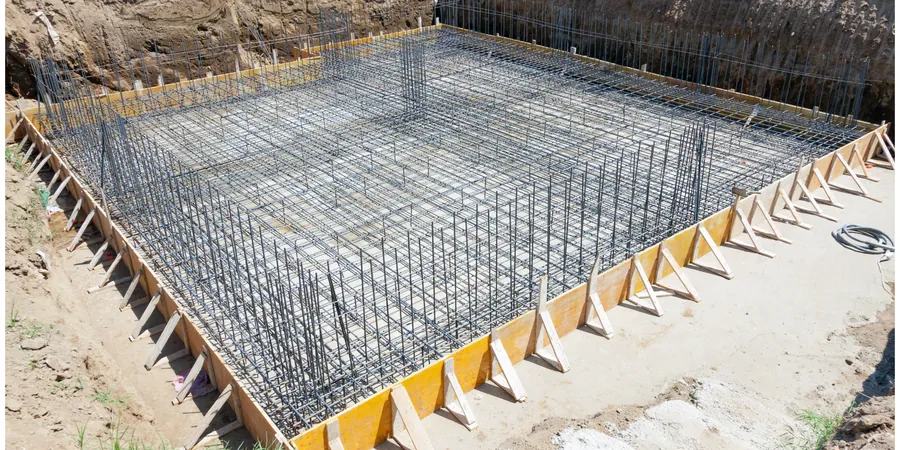
In Delta BC, raft foundation design must account for creep settlements that can continue for over a decade after construction due to deep organic silt layers.
Methodology applied in Delta BC
Local geotechnical conditions in Delta BC
In Delta BC, many times we see that designers underestimate the impact of secondary compression in the deep silt deposits. These soils exhibit a creep index that can account for 30 to 50 percent of the total long-term settlement, yet it's often omitted from standard consolidation analyses. Another common oversight is the effect of negative skin friction on piles that are combined with a raft — the downdrag from the settling soil mass can overload the foundation elements. We always flag this risk during the peer review phase and recommend including a settlement monitoring program with vibrating wire piezometers to track pore pressure dissipation over the first two years of the structure's life.
Our services
We tailor each raft foundation design to the specific soil profile and structural loads of your project. Our services cover the full cycle from field investigation to final structural recommendations.
Geotechnical Investigation for Raft Design
Boreholes advanced to 30 meters depth with Shelby tube sampling, CPTu soundings, and in-situ vane shear tests to characterize the soft clay and silt layers.
Settlement and Bearing Capacity Analysis
Finite element modeling using Plaxis 2D/3D to predict total and differential settlements under service loads, including creep and consolidation components.
Raft Structural Sizing & Reinforcement Design
Dimensioning of mat thickness, steel reinforcement layout, and edge stiffness based on subgrade reaction modulus and punching shear checks per CSA A23.3.
Frequently asked questions
What is a raft or mat foundation, and when is it used in Delta BC?
A raft foundation is a continuous concrete slab that supports the entire structure, spreading loads over the full footprint. In Delta BC, it's used when shallow soils are too weak for individual footings but a pile system would be over-engineered — typically for low- to mid-rise buildings where the bearing capacity is between 40 and 80 kPa.
What are the main geotechnical challenges for raft design in Delta BC?
The primary challenges are deep soft silt and clay deposits that cause large long-term consolidation settlements, and the presence of organic layers near the surface that can continue to compress for years. Seismic loading also requires evaluating liquefaction potential in loose sand lenses and the risk of cyclic softening in sensitive clays.
How much does a raft foundation design study cost in Delta BC?
The cost for a complete design study — including field investigation, laboratory testing, numerical modeling, and structural recommendations — typically ranges between CA$1,310 and CA$6,010 depending on the building footprint, number of boreholes, and complexity of the soil profile.