The Fraser River delta deposits that underlie much of Delta BC create a unique challenge for foundation engineers. These deep layers of soft silt and clay exhibit high compressibility and low shear strength, which means any new fill or embankment will trigger significant consolidation settlements over years. Preloading design without surcharge offers a controlled method to induce those settlements before construction begins, avoiding differential movements in finished structures. We combine field instrumentation with laboratory consolidation tests to predict settlement magnitudes and rates accurately. The approach works well in Delta BC because we can apply the design load gradually and monitor pore pressure dissipation through piezometers. Thick compressible strata in areas like Ladner and Tsawwassen demand careful staging to prevent stability failures during the preload period.
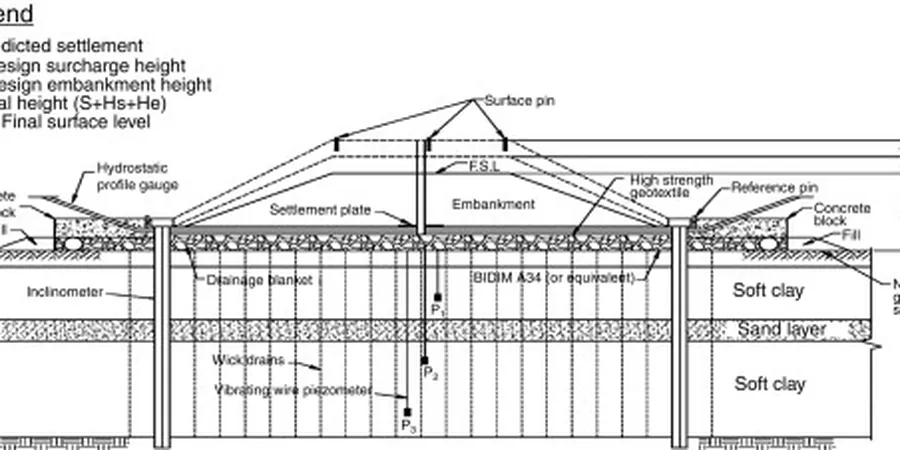
In Delta BC soft clays, staged fill placement with pore pressure monitoring reduces consolidation time from years to months without surcharge.
Methodology applied in Delta BC
Demonstration video
Local geotechnical conditions in Delta BC
The most common error we see in Delta BC is placing fill too fast. Contractors rush to meet schedule, apply 1.5 meters of preload in two weeks, and trigger a bearing capacity failure in the underlying clay. The result is a mud wave that displaces foundation soil sideways, ruining weeks of work and requiring complete removal and replacement. Another frequent mistake is ignoring secondary compression. In organic-rich deposits near Burns Bog the creep settlement after primary consolidation can reach 100 mm over five years. Without accounting for that in the preloading design without surcharge, the finished slab or pavement develops longitudinal cracks that are expensive to repair. Proper instrumentation and staged fill placement avoid both problems.
Our services
We offer three complementary services to support preloading design without surcharge in Delta BC.
Consolidation Testing & Analysis
Oedometer tests on undisturbed samples from Delta BC soft clays. We determine preconsolidation pressure (Pc), compression index (Cc), and coefficient of consolidation (Cv) for each stratum.
Settlement Monitoring & Back-Analysis
Installation of settlement plates, inclinometers, and piezometers. We collect weekly readings and update the Asaoka or hyperbolic settlement predictions throughout the preload period.
Fill Staging & Stability Review
Limit equilibrium slope stability checks for each fill lift. We verify that the factor of safety stays above 1.3 and adjust the preloading schedule if pore pressures rise too fast.
Frequently asked questions
How does preloading without surcharge differ from surcharge preloading?
Preloading without surcharge applies the design load equal to the final structure weight. Surcharge preloading uses additional fill to accelerate consolidation. Without surcharge, the consolidation time is longer but the risk of bearing capacity failure is lower, which suits Delta BC soft clays where shear strength is marginal.
How long does a typical preload period last in Delta BC?
For a 2-meter fill on 10 meters of soft clay, expect 6 to 12 months to reach 90 percent consolidation. The exact duration depends on the clay's coefficient of consolidation and the presence of drainage layers. We run back-analyses after the first 3 months to refine the timeline.
What monitoring instruments are needed for preloading without surcharge?
You need settlement plates every 25 to 30 meters, vibrating-wire piezometers at two depths per location, and inclinometers if the fill is near a slope. We also recommend survey monuments at the fill perimeter to detect lateral movement.
Can preloading without surcharge be used for residential slabs in Delta BC?
Yes, but only if the compressible soil thickness is less than 4 meters and the design bearing pressure stays below 50 kPa. For deeper clay deposits or higher loads, we recommend adding vertical drains or switching to a surcharge preloading scheme to keep the schedule practical.