A common mistake we see from contractors in Delta BC is assuming the silty soils near the Fraser River delta behave like the glacial tills found further inland. They pour asphalt over an unprepared subgrade, and within two winters the pavement cracks along settlement lines. The geotechnical reality here is layered: soft marine clays overlain by silt deposits with high moisture content. Without a proper subgrade evaluation and compaction control using subrasante vial criteria, the road base loses support. We have pulled core samples from Tilbury Island roads that failed because nobody checked the California Bearing Ratio before placing the first lift of aggregate. That is time and money you cannot recover.
Soaking CBR samples for 96 hours mimics spring thaw conditions — a critical step that many short-schedule jobs skip in Delta BC.
Methodology applied in Delta BC
Local geotechnical conditions in Delta BC
Compare the subgrade under Highway 17A near the Burns Bog with what you find west of the Tsawwassen ferry terminal. The bog side has up to 8 meters of fibrous peat under the road fill, while the terminal side sits on dense glacial outwash. That contrast is extreme but illustrates the point: Delta BC soils vary block by block. If you design pavement thickness based on a single test pit, you risk differential settlement at every property line. We have seen a four-lane arterial fail within three years because the designer used an average CBR of 8% when the actual subgrade ranged from 2% to 14% across the same stretch. That is why we advocate for a minimum of one CBR test per 150 meters of roadway alignment, plus a densidad-cono-arena test every lift during fill placement.
Our services
Our road geotechnics service covers the full chain from subgrade investigation to pavement design verification. For Delta BC projects, we tailor the scope to local soil variability and traffic category.
Subgrade Investigation & CBR Testing
We drill test pits and boreholes at 150-meter intervals along the alignment, extract undisturbed samples, and run soaked CBR tests per ASTM D1883. The results include layer-by-layer strength profiles and recommendations for subgrade improvement where CBR falls below 3%.
Pavement Structural Design
Using the AASHTO 1993 empirical method calibrated with our Delta BC test data, we calculate required asphalt thickness, base course depth, and drainage layer specifications. We account for the local frost penetration depth and the high water table to prevent spring breakup.
Compaction Control & Quality Assurance
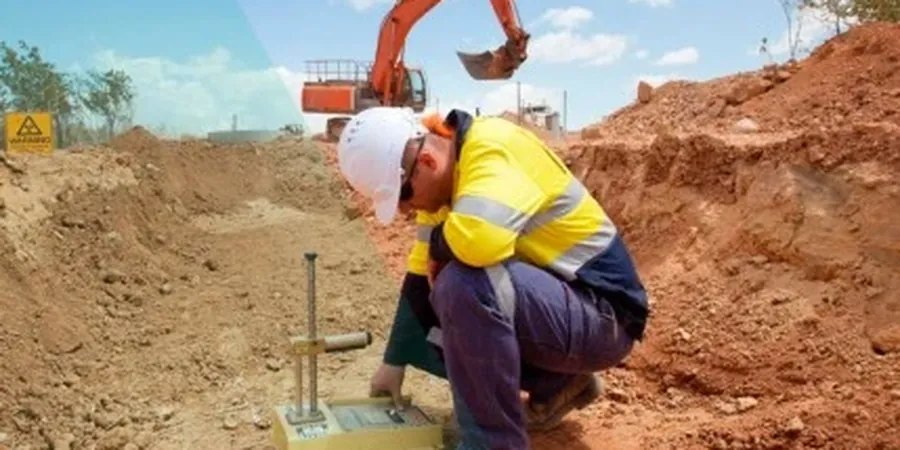
During fill placement, we verify compaction to at least 95% of Standard Proctor maximum dry density using nuclear density gauge and sand cone tests. We provide daily reports with pass/fail results so the contractor can adjust moisture content or roller passes in real time.
Frequently asked questions
What is the typical CBR value for subgrade soils in Delta BC?
In our experience, soaked CBR values for the native silty clays and peats in Delta BC range from 2% to 12%. The lower end is common near Burns Bog and the Fraser River foreshore, while higher values occur where glacial till or sand deposits are present. We always recommend site-specific testing rather than relying on published maps.
How does the high water table in Delta BC affect pavement design?
A water table within 1.5 meters of the subgrade surface reduces the effective CBR by 30% to 50% compared to dry conditions. We account for this by using soaked CBR values in the design and by specifying a free-draining granular base layer at least 300 mm thick to prevent capillary rise from saturating the subgrade.
What is the difference between Standard Proctor and Modified Proctor compaction tests?
Standard Proctor (ASTM D698 (also CFEM Ch 2) (also CFEM Ch 2) (also CFEM Ch 2) (also CFEM Ch 2) (also CFEM Ch 2)) applies a compaction effort of 12,400 ft-lbf/ft³, which simulates field compaction with light rollers. Modified Proctor (ASTM D1557 (also CFEM Ch 2) (also CFEM Ch 2) (also CFEM Ch 2) (also CFEM Ch 2) (also CFEM Ch 2)) uses 56,000 ft-lbf/ft³ to represent heavy traffic compaction. For Delta BC residential roads and light industrial access, Standard Proctor is usually sufficient. For major arterial roads, we recommend Modified Proctor specifications.
How many test pits do I need for a 1 km road project in Delta BC?
We recommend a minimum of six test pits per kilometer of roadway, spaced 150 meters apart, plus one additional pit at every major intersection or change in topography. This spacing captures the lateral variability common in Delta BC's deltaic deposits. For projects near Burns Bog or the Fraser River, we increase the density to one pit every 100 meters.
What is the typical cost range for a road geotechnics study in Delta BC?
A complete road geotechnics study including CBR testing, soil classification, and pavement design recommendations typically falls between CA$1.260 and CA$5.520 depending on the number of test pits, laboratory tests required, and the complexity of the alignment. We provide a fixed-price quote after reviewing the project scope.