Following CSA + CSA + CSA + CSA + ASTM D2435 (also CFEM Ch 2) (also CFEM Ch 2) (also CFEM Ch 2) (also CFEM Ch 2) (also CFEM Ch 2) and NBCC 2020, we perform oedometer consolidation tests on undisturbed samples from Delta BC to determine preconsolidation pressure, compression index, and coefficient of consolidation. The Fraser River delta deposits here are notoriously compressible — up to 300 meters of post-glacial sediments with organic layers — so accurate settlement parameters are critical before designing foundations, embankments, or surcharge programs. Our laboratory applies incremental loading stages up to 1600 kPa, with pore pressure dissipation monitoring, to deliver data that directly feeds into your geotechnical model. For shallow foundations we combine this with a capacity of load study to verify bearing resistance under long-term loads. When organic layers are suspected, we also run organic soils characterization to refine creep estimates.
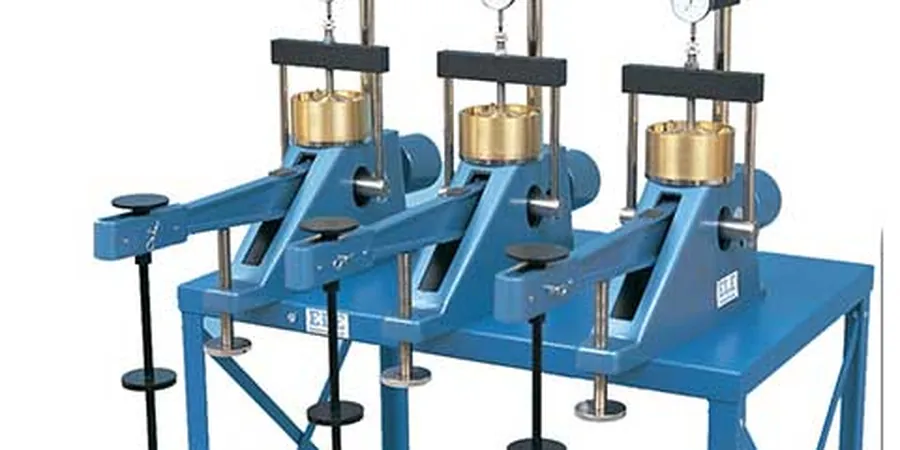
Primary consolidation in Delta BC's soft clays can exceed 50% of total settlement — ignoring secondary compression in peat layers risks long-term structural damage.
Methodology applied in Delta BC
Local geotechnical conditions in Delta BC
The Fraser River delta's high water content and low preconsolidation pressure make Delta BC particularly vulnerable to differential settlement under fill loads. A 3-meter highway embankment here can cause 1.5 meters of primary consolidation over 5 years if drainage paths are long. The risk multiplies when construction proceeds without waiting for pore pressure dissipation — shear strength gain is delayed and slope failures become more frequent. Our oedometer test identifies the exact time-rate of settlement so you can schedule staged construction safely.
Our services
We provide three specialized oedometer testing services tailored to Delta BC's soft soil conditions:
Incremental Loading Oedometer (Standard)
Eight-stage loading per CSA + CSA + CSA + CSA + ASTM D2435 (also CFEM Ch 2) (also CFEM Ch 2) (also CFEM Ch 2) (also CFEM Ch 2) (also CFEM Ch 2) on 50 mm diameter undisturbed specimens. Full time-settlement curve, Casagrande and Taylor construction, and report with σ'p, Cc, Cr, cv, and permeability (k). Ideal for preliminary foundation design in Delta BC's silty clay.
Constant Rate of Strain (CRS) Consolidation
Faster alternative to incremental loading, with continuous strain measurement at 0.5% to 5% per hour. Suitable for soft clays where pore pressure generation must be controlled. Provides cv and σ'p in hours instead of days.
Swelling/Collapse on Dry Samples
Measures swelling potential under inundation after unloading — critical for Delta BC's desiccated crust layers near the surface. Reports free swell (%), swelling pressure, and collapse index. Used to assess heave risk for shallow footings.
Frequently asked questions
What is the difference between oedometer consolidation test and triaxial test for settlement analysis?
The oedometer test measures one-dimensional compression under zero lateral strain, which replicates field conditions under wide foundations or embankments. It directly provides Cc, Cr, and cv. The triaxial test measures shear strength and pore pressure under controlled confinement — it gives parameters for stability analysis, not settlement magnitude. Both are complementary: oedometer for settlement, triaxial for bearing capacity.
How long does it take to complete an oedometer consolidation test in Delta BC?
Standard incremental loading with 8 stages requires 8 to 14 days depending on soil permeability. For low-permeability clays (cv < 1 m²/year), each load increment may take 48 hours to reach 100% primary consolidation. CRS testing can reduce this to 2–3 days but requires careful pore pressure control.
What is the typical cost of an oedometer consolidation test in Delta BC?
The cost for a standard incremental loading test with 8 stages and full report typically ranges between CA$300 and CA$590 per specimen. CRS testing is slightly higher due to specialized equipment. Volume discounts apply for multi-specimen projects, and additional stages (up to 12) incur extra charges.
When do I need an oedometer test versus just using empirical correlations?
Empirical correlations (e.g., Cc = 0.009*(LL-10)) are adequate for preliminary estimates but cannot replace site-specific testing when settlement tolerance is tight (< 25 mm) or when organic soils are present. Delta BC's variable stratigraphy — peat, clay, silt lenses — means empirical values can overestimate or underestimate settlement by 40% or more. We recommend oedometer testing for all projects with fills exceeding 2 meters or structures with stringent differential settlement limits.