A common mistake among contractors developing sites in Delta BC is assuming any granular backfill works for an MSE wall. The Fraser River delta deposits include deep layers of soft clay and peat that can generate lateral pressures far beyond what a standard design assumes. Without proper characterization of the native foundation soils and the reinforced fill, the wall may experience excessive deformation or even internal instability. Before specifying reinforcement strips or geogrids, a thorough subsurface investigation is essential. Many teams also overlook the need to assess long-term drainage within the reinforced zone, which directly affects the durability of the steel or polymer elements. The combination of high groundwater and organic soils in Delta BC demands a design approach that accounts for both static and seismic loading conditions under NBCC 2020. Pairing the MSE wall analysis with a geotechnical slope stability study helps verify the global factor of safety when the wall is built on compressible ground.
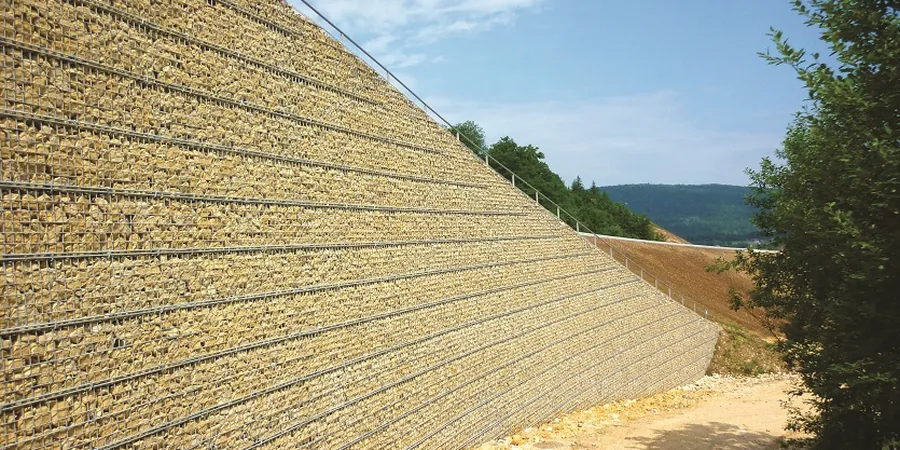
The combination of peat and soft clay in Delta BC means MSE walls must account for foundation settlement and seismic lateral spreading, not just internal reinforcement tension.
Methodology applied in Delta BC
Local geotechnical conditions in Delta BC
In Delta BC, we often see MSE walls designed with standard reinforcement lengths that ignore the deep soft clay beneath. The result is a wall that tilts forward over time as foundation consolidation generates differential settlement. Another risk arises when the reinforced fill is placed during wet weather and compaction targets are not met — the internal friction angle drops, and the reinforcement may never engage properly. Seismic design is critical here because the region is in a moderate seismic zone, and the soft soils amplify ground motions. If the wall is not designed to tolerate lateral spreading, the entire structure can shift during an earthquake. Finally, corrosion of steel strips in the high-water-table environment of Delta BC is a real concern; polymer geogrids or galvanized steel with proper coating specifications should be considered from the start.
Our services
Our team delivers comprehensive MSE wall design services tailored to the geotechnical conditions of Delta BC, from conceptual design through construction monitoring.
Full MSE Wall Design & Analysis
We perform internal and external stability calculations using limit equilibrium and finite element methods, incorporating site-specific soil parameters from our laboratory testing. The design includes reinforcement layout, facing panel specifications, and drainage detailing per NBCC 2020 and FHWA guidelines.
Construction Support & Quality Control
During construction, we provide fill material testing (gradation, compaction), reinforcement placement inspection, and pullout verification tests. Our engineers monitor wall alignment and settlement to ensure the as-built structure matches the design assumptions for the Delta BC site.
Frequently asked questions
What is the typical cost range for an MSE wall design in Delta BC?
The cost for a complete MSE wall design package, including geotechnical investigation, stability analysis, and construction drawings, typically ranges between CA$1.880 and CA$7.230 depending on wall height, foundation conditions, and the level of seismic analysis required.
What types of reinforcement are recommended for Delta BC's organic soils?
For sites with high groundwater and organic content, polymer geogrids are often preferred over steel strips because they are not susceptible to corrosion. However, galvanized steel strips with a minimum coating thickness can also be used if the drainage system is properly designed. The choice depends on the design life and the pH of the backfill and groundwater.
How does the soft clay in Delta BC affect the MSE wall foundation?
The soft clay layers (typically 5 to 15 m deep) have low undrained shear strength and high compressibility. This means the wall foundation must be designed for bearing capacity and settlement. In many cases, a lightweight reinforced fill is specified, and the wall is built in stages to allow pore pressure dissipation. Soil improvement techniques like preloading or deep soil mixing may also be needed.
What seismic considerations are unique to MSE walls in Delta BC?
Delta BC is in a zone of moderate seismicity, but the soft soils amplify ground motions significantly. The MSE wall must be designed for a seismic coefficient (kh) between 0.10 and 0.18 per NBCC 2020 for Site Class D or E. Additionally, the potential for lateral spreading in the underlying clay during an earthquake must be evaluated, which may require longer reinforcement and a deeper embedment.