Delta BC sits on the Fraser River delta, a dynamic landscape of soft silts and clays with a high water table just a few feet down. This young sedimentary profile presents real challenges for underground structures. The saturated, low-strength soils demand careful geotechnical design of deep excavations to prevent bottom heave, wall instability, and excessive groundwater inflow. In this region, the Fraser River's seasonal flow and tidal influence directly affect pore pressures, requiring models that capture transient conditions. A solid design must also account for seismic loading from the Cascadia subduction zone. Before any shoring or soldier pile wall is specified, the team runs advanced stability checks using finite element software. For projects requiring precise lateral movement control, we often pair excavation modelling with instrumentation geotecnica to monitor wall deflection in real time.
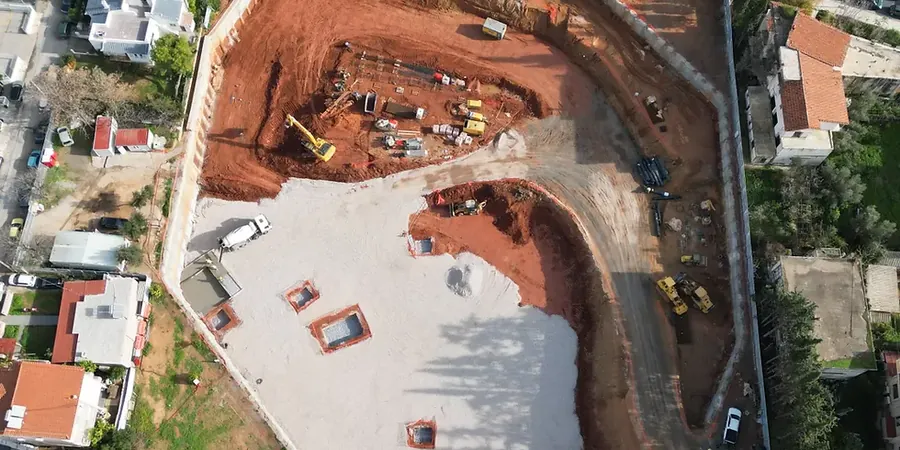
In saturated Fraser delta silts, wall deflection predictions can err by 30% if undrained shear strength is not measured at the correct strain rate.
Methodology applied in Delta BC
- Wall type selection (sheet pile, secant pile, or diaphragm wall) based on depth and adjacent structures
- Groundwater control via wells or cut-off walls, accounting for the regional aquifer
- Base stability analysis against piping and heave using Terzaghi's method
Demonstration video
Local geotechnical conditions in Delta BC
The biggest risk during deep excavations in Delta BC is uncontrolled groundwater inflow. The Fraser River delta has a shallow aquifer under artesian pressure in some zones, especially near the Boundary Bay shoreline. If the excavation bottom is below the piezometric head, a quick condition can develop, leading to piping failure and sudden loss of support. We've seen cases where a 6-meter excavation in silty sand collapsed in minutes because the sheet pile toe did not penetrate the confining layer. That's why every geotechnical design of deep excavations in Delta BC must include a detailed seepage analysis with appropriate factor of safety. Our engineers run transient flow models that account for tidal fluctuations, which can raise the hydraulic gradient by 20% during high tide.
Our services
Our team delivers the full scope of services needed to design and execute deep excavations safely in Delta BC's challenging ground conditions.
Soil Parameter Characterization
We determine the undrained shear strength, stiffness, and permeability of the deltaic soils through lab testing (triaxial, oedometer) and in-situ tests like CPT and SPT, all under ISO 17025 accreditation.
Structural Wall & Support Design
We design sheet pile walls, soldier piles with lagging, and secant pile walls, including strut or tieback systems. Each design includes deflection control and connection detailing per CSA A23.3.
Construction Monitoring & Verification
We provide real-time monitoring of wall movements, groundwater levels, and adjacent settlement using inclinometers, piezometers, and automated data loggers, with daily reporting to the contractor.
Frequently asked questions
What is the typical cost range for geotechnical design of deep excavations in Delta BC?
For a standard deep excavation project in Delta BC, the design and analysis phase typically costs between CA$2.670 and CA$11.490, depending on the depth, soil complexity, and monitoring requirements. This includes field investigation, lab testing, numerical modelling, and a detailed design report.
Why is the Fraser River delta soil so challenging for deep excavations?
The deltaic soils are soft, highly compressible, and often interbedded with sand lenses. The high water table and seasonal tidal fluctuations create variable pore pressures. These conditions increase the risk of basal heave, wall deflection, and piping if the design does not properly account for effective stress changes during excavation.
What factor of safety does the NBCC require for basal heave in deep excavations?
The NBCC 2020 does not prescribe a single factor for basal heave, but the industry standard in Delta BC is a minimum of 1.5 against heave, and 1.3 against piping. Our designs typically target 1.6 to account for the uncertainty in the layered deltaic profile.
Do I need a hydrogeological study for a deep excavation in Delta BC?
Yes, almost always. The Fraser River delta has a complex aquifer system with confined and unconfined zones. A hydrogeological study is essential to determine the design groundwater level, estimate inflow rates, and plan dewatering or cut-off measures. Without it, the risk of a water-related failure is high.