A common mistake contractors make in Delta BC is selecting geogrid reinforcement based on tensile strength alone, ignoring the soil-geogrid interaction. The local deltaic silts and peaty layers often cause premature pullout failure when the aperture size isn't matched to the aggregate. A proper geogrid specification must account for the site's low bearing capacity, high groundwater table, and potential for differential settlement. Before writing a spec, it pays to cross-check the soil classification with a clasificación de suelos to understand the particle distribution. The base course thickness also changes with grid stiffness. We see projects fail when designers use a generic biaxial grid without verifying junction efficiency under Delta BC's moist conditions. Every spec should reference the project's specific fill material and compaction requirements.
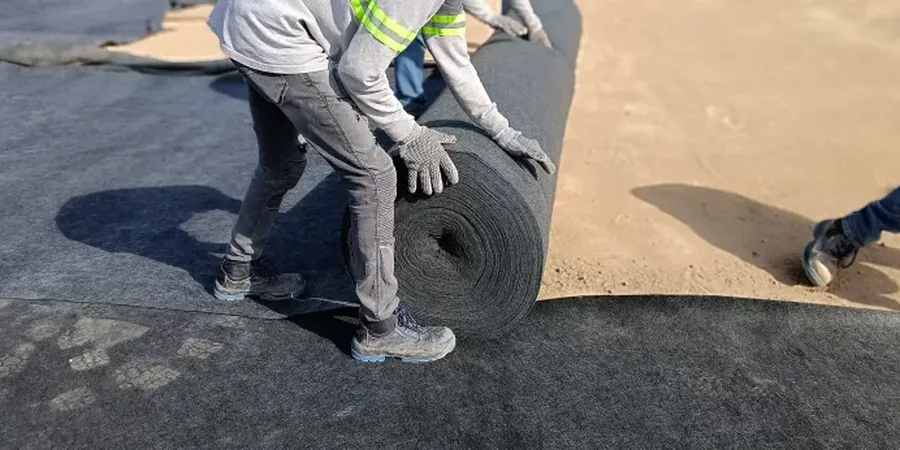
Geogrids in Delta BC must resist creep under sustained load. Junction efficiency above 90% is non-negotiable for roadbase over deep organic silts.
Methodology applied in Delta BC
Local geotechnical conditions in Delta BC
In North Delta, the soils transition from Fraser River sands to organic peat near Burns Bog. A geogrid spec that works on the sandy side may fail completely in the peaty zones where pullout capacity drops by half. Meanwhile, in Tsawwassen, the glacial till provides better anchorage but the grid must handle higher seismic loads. The difference is stark. Using a single spec across Delta BC ignores these variations. We've seen road shoulders crack within a year when a grid designed for sand was placed over peat without adjusting aperture size and junction strength. Each sector needs a dedicated geogrid specification that reflects the actual subgrade conditions.
Our services
Our geogrid specification service covers two critical phases of project development in Delta BC.
Design and selection
We analyze subgrade conditions, fill properties, and project loads to define the geogrid type, tensile strength, aperture geometry, and material formulation per ASTM and GRI standards.
Construction specification and QA
We write detailed installation specs covering overlap, anchorage, compaction sequence, and quality control testing to ensure the geogrid performs as designed in the field.
Frequently asked questions
What tensile strength is typically required for geogrids in Delta BC road projects?
For roadbase over soft deltaic soils, we typically specify a minimum tensile strength of 30 kN/m at 2% strain per ASTM D6637. Heavier loads or steeper subgrades may require 40 kN/m. The value comes from limit equilibrium analysis against subgrade bearing failure and lateral spreading.
How does the high water table in Delta BC affect geogrid specification?
The high water table reduces effective stress and lowers pullout capacity. We account for this by specifying grids with higher junction efficiency (>90%) and larger aperture sizes to mobilize passive resistance from the fill. Drainage layers may also be needed to prevent pore pressure buildup during compaction.
What is the typical cost range for a geogrid specification study in Delta BC?
A full geogrid specification including subgrade analysis, design calculations, and installation QA documentation typically ranges from CA$570 to CA$1,940 depending on project complexity and site access. The cost reflects the site-specific testing and engineering required for Delta BC's variable soils.