The NBCC and CSA A23.2-9A / CSA A23.2-9A / CSA A23.2-9A / CSA A23.2-9A / CSA A23.2-9A / ASTM D1586 guide geocell design in Delta BC, where soft deltaic soils and high groundwater demand careful confinement analysis. This area sits on the Fraser River floodplain, with silt and peat layers that require geocell reinforcement to distribute loads and prevent rutting. Our team evaluates bearing capacity and settlement potential before specifying cell geometry, infill material, and connection methods. We also consider seismic conditions under NBCC 2020 for sites near the Georgia Strait. The goal is to match cell depth, weld spacing, and polymer grade to the subgrade strength found in Delta BC.
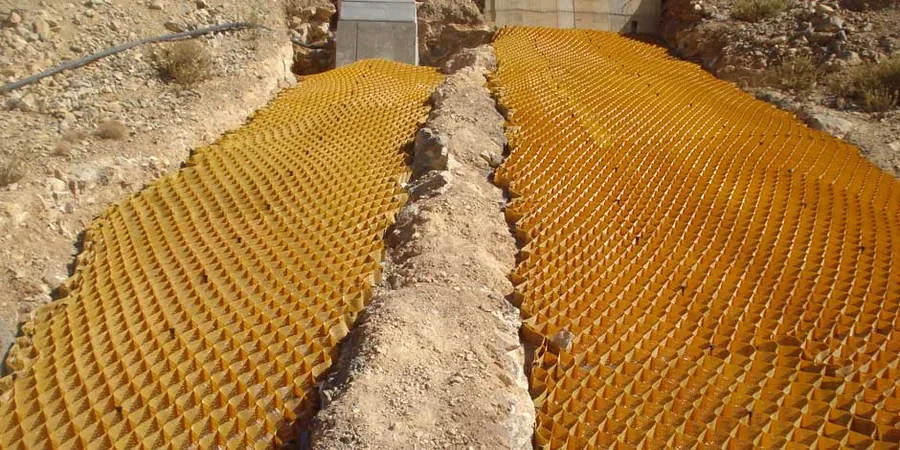
Geocell design in Delta BC must account for peat compression up to 30% more than silt — cell geometry alone is not enough.
Methodology applied in Delta BC
Local geotechnical conditions in Delta BC
Without proper geocell design, Delta BC sites risk differential settlement that cracks adjacent pavement or retaining walls. The soft estuarine soils amplify this when seasonal rains saturate the subgrade. We have seen cases where unconfined gravel shoulders slumped 150 mm within two years. Using NBCC seismic drift limits, we model how geocell confinement reduces lateral spreading during a magnitude 7 event. The analysis includes pullout resistance at panel joints and interface shear between geocell and underlying silt. This prevents progressive failure along slope toes or under traffic loads.
Our services
Our geocell design services cover the full workflow from site investigation to construction support in Delta BC.
Subgrade characterization
Boreholes and SPT tests to classify soil layers and measure water table depth before geocell layout.
Cell geometry optimization
Parametric analysis of cell depth, seam spacing, and infill type for load distribution and slope stability.
Construction QA/QC
Field compaction tests and panel pullout checks to verify installation meets design specs.
Frequently asked questions
What is the typical cost range for geocell design in Delta BC?
The cost for geocell design and analysis in Delta BC ranges between CA$1.250 and CA$2.990, depending on site complexity, number of test pits, and design iterations required.
How does geocell design differ on peat versus silt soils in Delta?
Peat requires deeper cells (150–200 mm) and higher density infill to limit compression, while silt needs wider weld spacing to prevent cell rupture under traffic loads.
Do geocells improve seismic performance in Delta BC?
Yes — geocell confinement reduces lateral spreading and differential settlement during earthquakes by increasing the composite shear strength of the soil mass.
What infill material works best for geocells on soft subgrades?
Clean angular gravel (25–50 mm) compacted to 95% modified Proctor provides optimal load transfer and drainage on soft subgrades.