We recently worked on a site near the Burns Bog area in Delta BC where a four-storey residential building had to be founded on soft marine clays. The geotechnical engineer needed reliable undrained shear strength values to check bearing capacity and slope stability. That's exactly where the field vane shear test (VST) comes in. We deploy a vane borer directly into the borehole or push it from the surface, rotate it at a standard rate, and record the peak torque. The test gives you a direct measure of the soil's undisturbed shear strength in place — no sampling disturbance, no lab transport delays. For Delta BC, where thick sequences of soft clay and silt are common along the Fraser River delta, the VST is one of the most practical tools we have. We follow ASTM D2573-15 for every test and cross-check results with lab triaxial data when needed. Before we start, we often recommend a complementary cone penetration test (CPT) to get a continuous profile of soil behavior and pore pressure response across the entire depth.
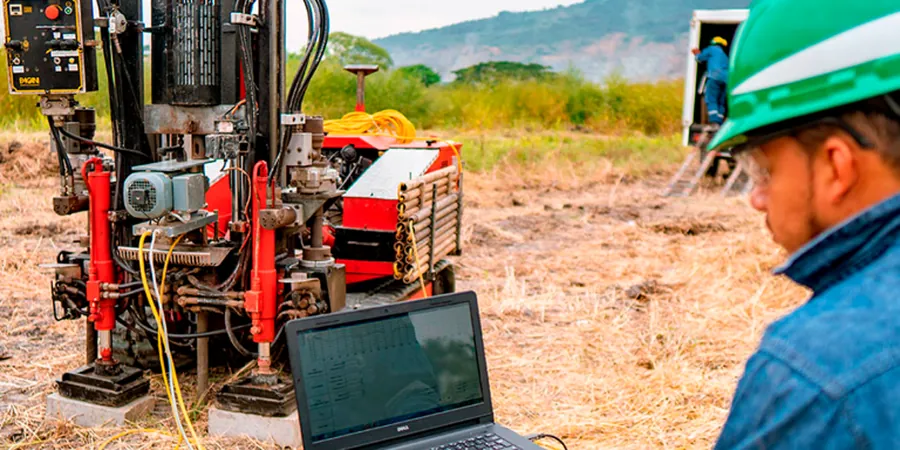
The VST directly measures undisturbed shear strength in soft clays — no sampling disturbance, no lab delays. Essential for Delta BC's soft deltaic soils.
Methodology applied in Delta BC
- Peak torque and residual torque
- Vane dimensions and depth
- Rate of rotation
- Soil description (visual classification per CFEM)
Local geotechnical conditions in Delta BC
Delta BC sits on the Fraser River delta, a young sedimentary basin built by millennia of silt and clay deposition. The top 10 to 20 meters are mostly soft, compressible marine clays with high water content and low shear strength. Urban development here has grown fast since the 1960s, particularly in North Delta and along the waterfront. The biggest geotechnical risk? Undetected weak layers that can trigger differential settlement or foundation failure under moderate loads. A field vane shear test (VST) catches those weak zones in real time. If you skip it, you might design a foundation based on average lab data that misses a 2-meter soft pocket at 8 meters depth. We've seen it happen. The test is also critical for slope stability in the dykes and embankments that protect low-lying areas from flooding. Without a VST, the risk of undrained failure during a seismic event or rapid drawdown is real.
Our services
Beyond the field vane shear test, we offer complementary in-situ and laboratory services tailored for Delta BC's soft ground conditions.
Undrained Shear Strength Profiling
We provide a full depth profile of Su using VST at multiple depths, combined with pocket penetrometer and torvane tests on undisturbed samples. Results are delivered with graphical profiles and interpreted for foundation design and slope stability analysis.
VST for Embankment and Levee Stability
For dykes, levees, and road embankments in Delta BC, we run VSTs along alignment at critical sections. The data feeds directly into limit equilibrium slope stability models. We also correlate VST results with lab fall cone and triaxial tests for cross-validation.
Frequently asked questions
How much does a field vane shear test cost in Delta BC?
A standard field vane shear test in Delta BC typically ranges between CA$810 and CA$1,800 per test depth, depending on access conditions, number of depths, and whether a drill rig is needed for advance. Volume discounts apply for multiple test points on the same site.
What is the difference between VST and CPT for measuring shear strength?
The VST directly measures the undrained shear strength by rotating a vane in the soil, giving a discrete value at a specific depth. The CPT (cone penetration test) measures tip resistance and sleeve friction continuously, from which Su is estimated using empirical correlations. In Delta BC's soft clays, we often run both: VST for direct Su at critical depths and CPT for a continuous profile to identify thin weak layers.
At what depths do you typically perform VST in Delta BC?
We perform VSTs at 1.5-meter intervals starting from 1.0 m below ground surface, down to the depth where the soil becomes too stiff or the rod buckles (usually around 20–30 m). In Delta BC, the most critical soft clay layers are typically between 3 m and 15 m depth, so we concentrate tests there. The engineer can specify any custom depths based on the project's needs.