Under ASTM D1556 and the National Building Code of Canada, the sand cone method remains the standard for verifying compaction in engineered fills across Delta BC. The lower Fraser River delta deposits here are predominantly silty sands and soft clays, where achieving specified dry density is critical for long-term settlement control. This test determines in-place density by excavating a small test hole, filling it with calibrated sand from a jar, and weighing the recovered material. For shallow fills and trench backfill the sand cone offers a direct, repeatable measure that nuclear gauges cannot always match, especially near moisture-sensitive soils where probe insertion may disturb the matrix. Before placing structural fill on compressible delta soils, it is often wise to combine this test with a consolidation analysis to understand long-term volumetric behavior under load.
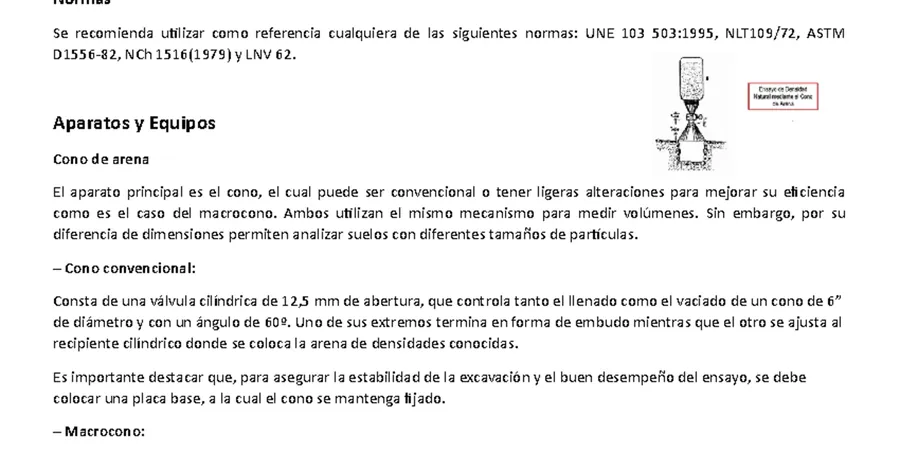
The sand cone method provides a direct volumetric measure of in-place density without the calibration drift that can affect nuclear gauge readings on moist delta soils.
Methodology applied in Delta BC
- Direct volumetric measurement eliminates radiation licensing issues common with nuclear gauges
- Suitable for cohesive and granular soils up to 50 mm particle size
- Results reported as dry density (kg/m³) and percent relative compaction against Proctor maximum
Local geotechnical conditions in Delta BC
The Fraser River delta underlying most of Delta BC consists of up to 200 meters of Holocene sediments, including loose sands, soft silts, and compressible clays. These deposits are highly sensitive to vibration and changes in pore pressure; improper compaction control can trigger differential settlement within months of occupancy. Field density testing with the sand cone method directly measures the achieved dry density at each compacted lift, giving the engineer real-time data to adjust roller passes, moisture content, or lift thickness before the next layer is placed. Without this verification, a fill that appears stiff on the surface may still contain low-density zones that consolidate under service loads, leading to cracked slabs or uneven pavement.
Our services
We offer two complementary field density testing options tailored to different project scales and site conditions in Delta BC.
Standard Sand Cone Density Test
Full ASTM D1556 compliant testing for engineered fills, utility trench backfill, and structural base courses. Includes excavation, sand calibration, moisture determination, and percent compaction reporting. Recommended for projects up to 10,000 m³ of controlled fill.
High-Frequency Compaction Control
Intensive testing program for large-scale earthworks, embankments, and road subgrades. Technicians perform sand cone tests at intervals as frequent as one per 100 m³, with same-day reporting of dry density curves and moisture-density relationships. Ideal for the deep fills common in Delta BC's industrial developments.
Frequently asked questions
How does the sand cone method compare to a nuclear density gauge?
The sand cone method measures volume directly by filling the excavated hole with calibrated sand, eliminating radiation licensing requirements and the calibration drift that can affect nuclear gauges on moist delta soils. It is generally more accurate in silty or clayey materials but takes longer per test — about 15 to 20 minutes versus 2 minutes for a nuclear gauge.
What is the typical cost range for a sand cone field density test in Delta BC?
A single sand cone density test in Delta BC typically ranges from CA$150 to CA$220 per test point. Volume discounts apply for programs of 20 or more tests, and mobilization fees may be added for sites outside the immediate Delta area.
How many sand cone tests are required per volume of fill?
The NBCC and most municipal specifications in Delta BC require one field density test per 500 m³ of placed fill for structural fills, and one per 250 linear meters of trench for utility backfill. High-risk areas such as bridge approaches or industrial slabs may require testing every 150 m³.
Can the sand cone method be used on wet or saturated soils?
The reference range for this service in Delta BC is CA$150 - CA$220. The final price depends on the project scope and volume.
What is the maximum particle size allowed for sand cone testing?
ASTM D1556 limits the sand cone method to soils with a maximum particle size of 50 mm. If the fill contains larger particles (gravel or cobbles), the test hole volume becomes unreliable, and alternative methods such as the sand replacement test with larger apparatus or the nuclear gauge must be used.