A six-story condo project on Delta BC's floodplain required a foundation that could handle deep soft soils. Driven piles transfer loads through surficial peat and silt down to denser sand layers. We ran SPT borings to refusal and used CPT data to model shaft friction and end bearing. The design followed NBCC 2020 seismic provisions for the Fraser River delta. Before finalizing the pile layout, we cross-checked results with a microzonificación sísmica study to capture local amplification effects. That extra step saved the developer from over-designing pile lengths.
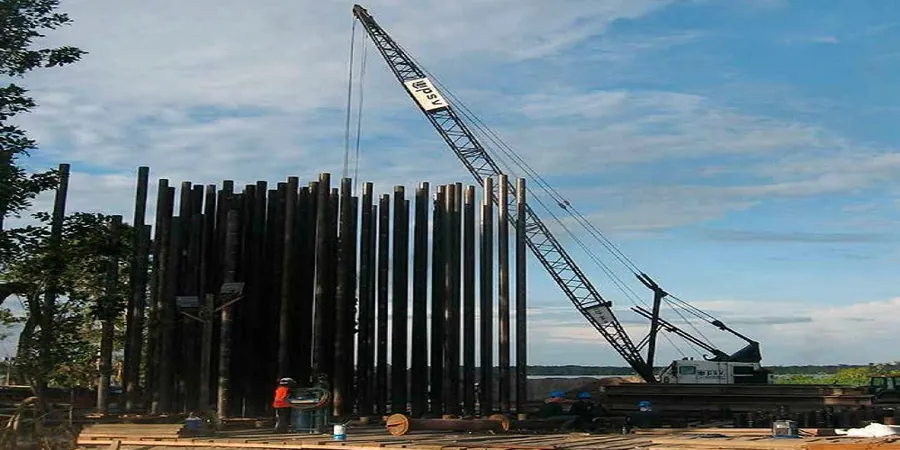
Driven pile design in Delta BC must account for the soft marine clay crust and potential downdrag from deep peat layers.
Methodology applied in Delta BC
- Skin friction along pile shaft
- End bearing capacity at tip
- Group efficiency and settlement
- Negative skin friction in settling soils
Local geotechnical conditions in Delta BC
NBCC 2020 classifies Delta BC as a high seismicity zone with liquefaction potential in the Fraser delta soils. Driven piles must resist lateral spreading and cyclic degradation. We design for a minimum factor of safety of 2.0 under seismic loading. Pile groups in soft clays also risk downdrag from ground settlement. We model that using long-term consolidation data from oedometer tests. Ignoring these risks leads to differential settlement or pile buckling in a seismic event. Our reports include explicit liquefaction triggering analysis per Youd-Idriss (2001) and NCEER guidelines.
Our services
We offer a full suite of driven pile design services for Delta BC projects:
Geotechnical Investigation & Soil Logging
SPT borings, CPT soundings, and continuous sampling to define stratigraphy down to pile depth.
Pile Capacity Analysis
Static and dynamic formulas calibrated with local load test data. Skin friction and end bearing calculations.
Seismic & Liquefaction Assessment
Liquefaction triggering, lateral spread displacement, and pile group seismic demand per NBCC 2020.
Settlement & Group Effect Modeling
Elastic and consolidation settlement of pile groups. Downdrag evaluation in soft compressible soils.
Frequently asked questions
How is driven pile design different in Delta BC compared to other regions?
Delta BC's Fraser River delta soils include deep peat, soft silts, and loose sands. Driven piles must be designed for negative skin friction from settling peat layers and potential liquefaction in loose sand lenses. We account for these using site-specific CPT and SPT data.
What standards do you follow for driven pile design in Canada?
We follow NBCC 2020 for seismic and structural loads, CSA A23.3 for concrete piles, and ASTM D3966 for load testing. All design reports reference these codes explicitly.
What is the typical cost range for driven pile design in Delta BC?
The cost for a full geotechnical investigation plus driven pile design typically ranges between CA$1.900 and CA$5.970. This covers field work, lab testing, analysis, and a stamped report. Volume discounts apply for multi-building sites.
Can you design driven piles for a site with existing structures nearby?
Yes. We assess vibration and displacement risks using wave propagation models and recommend low-vibration methods like pre-augering or jetting if needed. Our reports include setback distances and monitoring protocols.